
Learn to Read Quran is an important goal for Muslims who want to read the Quran accurately, understand its written words, and develop confidence in recitation. However, beginners may initially struggle with Arabic letters, unfamiliar sounds, connected writing, and vowel marks, particularly if they have never studied Arabic before.
The good news is that learning Quran reading does not require previous knowledge of conversational Arabic. Instead, students can begin with the alphabet, understand how letters are pronounced, practice their different written forms, and gradually move toward reading complete Quranic verses.
A structured learning approach makes this process easier. By following manageable lessons, practicing consistently, and receiving corrections from a qualified teacher, beginners can develop the skills needed to read Quranic text with greater accuracy.
For students who prefer online education, Hamel El-Quran Academy provides individual lessons, qualified teachers, flexible scheduling, and student progress tracking. These features can support learners as they work through different reading stages.
This guide explains how to start with the Arabic alphabet, understand vowel signs, read connected words, practice the first page of the Quran, and develop proper recitation skills. It also explores common beginner mistakes and practical exercises that can make daily learning more effective.
Can Beginners Learn to Read Quran Without Knowing Arabic?

Yes. Beginners can develop Quran reading skills without speaking or understanding conversational Arabic. The first requirement is to recognize the Arabic alphabet and understand how its letters combine to form words.
Quranic Arabic follows specific pronunciation and reading principles. Therefore, students should learn
more than the names of individual letters. They also need to recognize their sounds, understand their written forms, and identify the signs that affect pronunciation.
A beginner-friendly learning sequence generally follows these stages:
- Recognize the 28 Arabic letters.
- Learn the correct pronunciation of each letter.
- Understand how letters connect within words.
- Study short vowels and other reading signs.
- Practice combining letters into simple words.
- Begin reading short Quranic passages.
- Develop accurate pronunciation through Tajweed.
Each stage prepares learners for the next one. For example, understanding connected letters makes it easier to recognize unfamiliar Quranic vocabulary.
Moreover, beginners should not compare their progress with other students. Some people recognize the alphabet quickly, while others need additional time to distinguish similar sounds.
The most effective approach is to establish strong foundations before increasing the difficulty of reading exercises.
How to Learn to Read Quran: 7 Essential Steps
Learning Quran reading becomes more manageable when the process is divided into smaller educational goals. Rather than attempting to read an entire page immediately, beginners should master one skill before moving to another.
The following steps provide a practical pathway for developing reading abilities.
1. Learn the Arabic Alphabet for Quran Reading
The first step to learning to read the Quran is becoming familiar with the Arabic alphabet.
Arabic contains 28 basic letters, each with its own name, shape, and pronunciation. Some sounds may be unfamiliar to English speakers, so students should study them carefully instead of relying only on memorization.
The Arabic alphabet includes:
- Alif (ا)
- Baa ( ب)
- Taa (ت)
- Thaa (ث)
- Jeem (ج)
- Haa (ح)
- Khaa (خ)
- Daal (د)
- Thaal (ذ)
- Raa (ر)
- Zaay (ز)
- Seen (س)
- Sheen (ش)
- Saad (ص)
- Daad (ض)
- Taa (ط)
- Zaa (ظ)
- Ayn (ع)
- Ghayn (غ)
- Faa (ف)
- Qaaf (ق)
- Kaaf (ك)
- Laam (ل)
- Meem (م)
- Noon (ن)
- Haa (ه)
- Waw (و)
- Yaa (ي)
Beginners should learn the letter names, recognize their shapes, and listen to their correct sounds. For instance, س and ص may seem similar to someone unfamiliar with Arabic, but they have different articulation characteristics. Similarly, ح and ه should not be treated as interchangeable sounds.
Practical exercise: Select five letters each day. Look at their written forms, listen to their pronunciation, and repeat each sound several times. Once you can recognize them confidently, introduce another group.
This method builds the foundation for Arabic alphabet Quran learning without overwhelming beginners with too much information at once.
2. Practice Correct Arabic Letter Pronunciation
Recognizing written letters is different from producing their sounds accurately.
Arabic contains several letters that require articulation points not commonly found in English. Consequently, beginners may pronounce unfamiliar sounds incorrectly when they depend entirely on written explanations.
Consider these examples:
- ح requires a distinct throat articulation.
- ع originates from the middle region of the throat.
- ق has a different articulation point from ك.
- خ has a characteristic sound produced in the upper throat region.
- ض requires attention to its specific articulation and characteristics.
These distinctions matter because changing a letter’s pronunciation can affect the meaning of a Quranic word.
To improve pronunciation, learners should:
- Listen to a qualified teacher pronounce each letter.
- Repeat the sound slowly.
- Compare letters with similar pronunciation.
- Practice difficult sounds separately.
- Recite the letters aloud and request corrections.
Additionally, recording your own practice can help you identify sounds that need more attention.
However, recordings and digital resources should complement direct instruction. A teacher can explain articulation problems and demonstrate the correct pronunciation in ways that independent practice may not provide.
3. Understand the Different Shapes of Connected Arabic Letters
After recognizing individual letters, beginners need to understand how Arabic writing works inside words.
Arabic is written from right to left. Most letters connect to neighboring letters, and their written appearance changes depending on their position.
A letter may have four forms:
- Isolated: When it appears independently.
- Initial: When it appears at the beginning of a connected word.
- Medial: When it appears between connected letters.
- Final: When it appears at the end of a connected word.
For example, the letter ب can appear as ب، بـ، ـبـ، and ـب.
This distinction is essential because a beginner who recognizes only isolated letters may struggle to identify them in Quranic words.
Another important detail is that six Arabic letters do not connect to the letter that follows them in writing:
ا، د، ذ، ر، ز، و
These letters can connect to the preceding letter when applicable, but they do not join the next letter.
For example, understanding the writing behavior of د and ر helps learners recognize word boundaries and connected forms more easily.
A useful progression includes:
| Practice level | Example |
|---|---|
| Individual letters | ب، ت، ن |
| Connected combinations | با، تب |
| Short Arabic words | باب، كتب |
| Quranic vocabulary | Words selected from the Mushaf |
Spend enough time on this stage before attempting longer passages. It helps students move from recognizing symbols to reading complete words.
4. Learn Basic Arabic Vowel Marks
Vowel marks are essential for reading Quranic words correctly. Although beginners may recognize the letters, they must also understand the small signs written above or below them. These marks influence how each letter is pronounced.
The first three signs to study are Fathah, Kasrah, and Dammah.
Fathah (َ)
Fathah appears above a letter and generally produces a short ‘a’ sound.
Example: بَ
Kasrah ( )
Kasrah appears below a letter and produces a short ‘i’ sound.
Example: بِ
Dammah (ُ)
Dammah appears above a letter and produces a short ‘u’ sound.
Example: بُ
Once students understand these signs, they can study additional reading marks.
- Sukoon (ْ): Indicates that a letter has no accompanying short vowel.
- Shaddah (ّ): Indicates that a letter is doubled or emphasized in pronunciation.
- Tanween (ً ٍ ٌ): Represents an additional n-sound ending, with pronunciation depending on the sign and applicable reading rules.
For effective practice, use the same letter with different vowel marks. Then repeat the exercise with other letters.
This method makes Quran alphabet learning more practical because students begin to understand how written signs influence actual pronunciation.
5. Understand the Difference Between Short Vowels and Long Vowels
After learning the basic vowel signs, beginners should study the Arabic letters used to represent long vowel sounds.
This distinction is important because short and long vowels affect how Quranic words are read.
The three main long-vowel letters are
- Alif (ا): Commonly extends the preceding Fathah.
- Waw (و): Can extend a preceding Dammah.
- Yaa (ي): Can extend a preceding Kasrah.
For example, students should learn to distinguish between a short vowel and a corresponding long vowel rather than treating both as having the same duration.
In Quranic recitation, elongation is connected to the rules of Madd. Therefore, beginners should first understand the basic difference and then learn the applicable Tajweed rules with their teacher.
Additionally, some Arabic letters can function differently depending on their position and vowel signs. This is why listening to accurate examples is especially helpful.
Practice short combinations before moving to longer words. Repeat them slowly and pay attention to the duration of each sound.
6. Start Reading Simple Quranic Words
Once learners recognize letters, connected forms, and basic vowel signs, they can begin practicing simple Arabic words.
At this stage, avoid selecting difficult Quranic passages. Instead, choose short combinations that allow you to apply the skills you have already developed.
Use this four-step method:
- Look carefully at the written word.
- Identify each letter and its vowel sign.
- Pronounce the individual combinations.
- Read the complete word slowly.
For example, students can begin with familiar short words before moving toward longer Quranic vocabulary.
Reading aloud is particularly useful because it connects visual recognition with pronunciation.
Furthermore, learners should avoid guessing unfamiliar words based on their appearance. Breaking a word into smaller combinations makes it easier to identify its letters and vowel marks.
Accuracy should come before speed. As recognition improves, reading becomes more natural and less dependent on identifying every letter separately.
7. Begin Reading the First Page of the Quran
After developing basic reading abilities, beginners can gradually move to the opening page of the Quran.
Surah Al-Fatihah provides a useful starting point because it contains seven verses and offers an opportunity to practice several familiar Arabic letter and vowel combinations.
Instead of attempting the complete passage immediately, divide it into smaller sections.
A practical learning sequence includes:
- Begin with the Basmalah.
- Identify the letters in the first verse.
- Recognize the vowel marks.
- Listen to an accurate recitation.
- Repeat the verse slowly.
- Review difficult words.
- Connect the verses gradually.
For example, when studying the opening words of Al-Fatihah, students should identify each letter, understand its pronunciation, and pay attention to the vowel signs.
Afterward, they can practice reading the complete verse while listening to a qualified reciter.
This exercise helps learners apply alphabet knowledge to authentic Quranic text rather than remaining limited to isolated reading examples.
8. Learn Basic Tajweed as Your Reading Improves
Learning to read quran involves recognizing written words and pronouncing them correctly. However, accurate Quranic recitation also requires understanding the principles of Tajweed.
Tajweed explains how Quranic letters should be articulated and how particular recitation rules should be applied.
Beginners can gradually study:
- Makharij Al-Huroof: Articulation points of Arabic letters.
- Sifat Al-Huroof: Characteristics of letters.
- Noon Sakinah and Tanween: Their different pronunciation rules.
- Meem Sakinah: Rules related to the letter Meem.
- Madd: Rules governing elongation.
- Qalqalah: The specific echoing quality of certain letters.
Nevertheless, students do not need to master every advanced rule before beginning Quran reading.
Instead, they should establish correct basic pronunciation and introduce additional rules as their skills develop.
Learn Quran Basics: What Should Beginners Study First?
Many beginners feel uncertain about where to start because Quran reading involves several connected skills.
A structured sequence can prevent confusion and make each lesson easier to understand.
| Learning skill | What students study | Main purpose |
|---|---|---|
| Arabic alphabet | Names and shapes of letters | Letter recognition |
| Pronunciation | Correct sounds and articulation | Accurate pronunciation |
| Connected writing | Different letter forms | Word recognition |
| Harakat | Fathah, Kasrah, and Dammah | Short vowel reading |
| Additional signs | Sukoon, Shaddah, and Tanween | More accurate reading |
| Long vowels | Alif, Waw, and Yaa | Understanding elongation |
| Word reading | Connected letters and sounds | Quranic vocabulary |
| Tajweed | Recitation principles | Improved recitation |
The learning sequence should reflect the student’s current ability. For example, someone who already recognizes Arabic letters may need more time to practice connected writing rather than repeating the entire alphabet.
How Long Does It Take to Learn Quran Basics?
There is no fixed learning period that applies to every beginner.
Some students recognize letters quickly, while others need additional time to distinguish similar sounds and understand vowel combinations.
Progress depends on several factors:
- Previous experience with Arabic.
- Age and individual learning pace.
- Frequency of practice.
- Quality of instruction.
- Regularity of revision.
- Opportunities to receive corrections.
Therefore, beginners should focus on achievable goals rather than expecting to read fluently within a predetermined number of days. A consistent routine is often more useful than occasional long study sessions.
Common Mistakes to Avoid When Learning Quran Reading
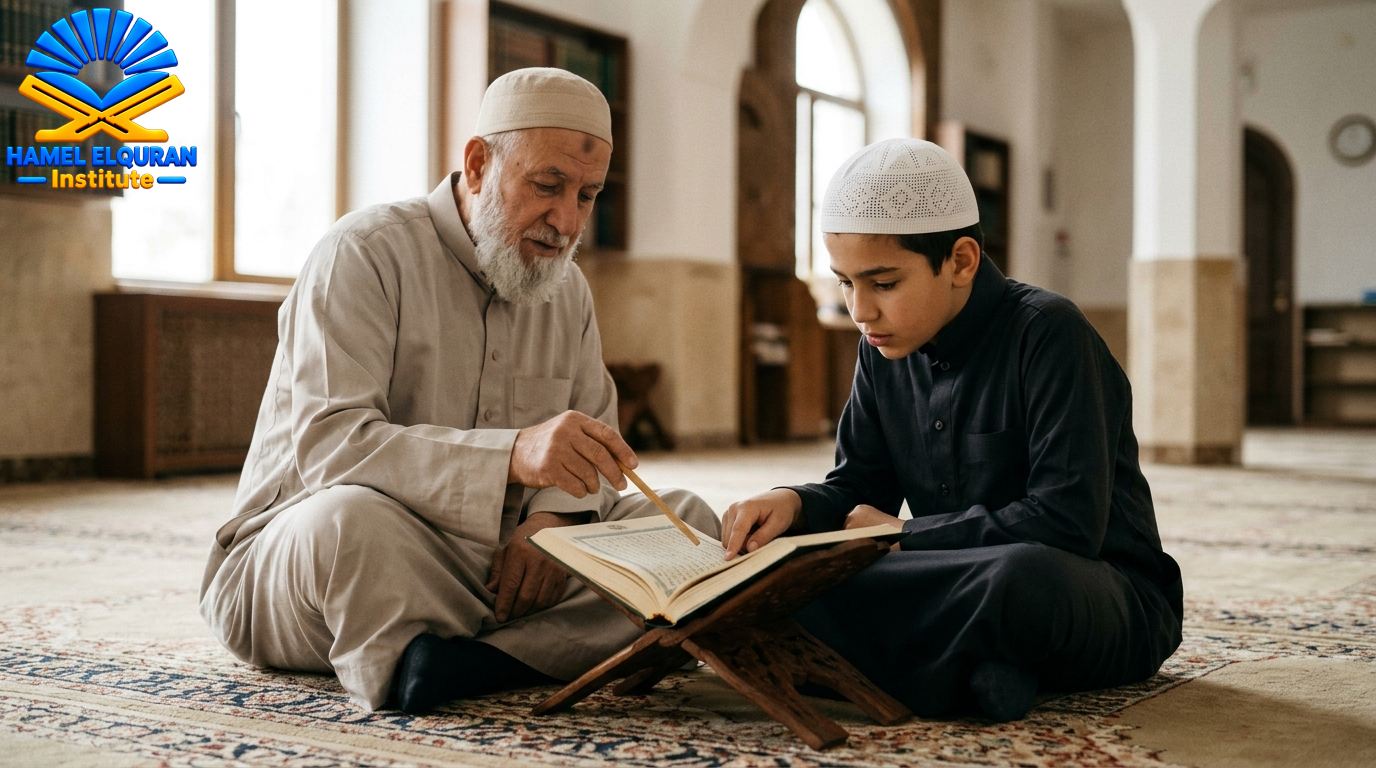
Recognizing common mistakes can help students develop better reading habits from the beginning.
Although mistakes are a normal part of learning, identifying them early makes it easier to correct pronunciation and reading problems.
Memorizing Letter Names Without Learning Their Sounds
Some learners memorize the Arabic alphabet but struggle to pronounce individual letters correctly.This happens because visual recognition and pronunciation are separate skills.To address this problem, combine written exercises with listening and speaking practice.
Ignoring Connected Letter Forms
Arabic letters may look different depending on their position within a word. Consequently, studying isolated letters alone does not provide sufficient preparation for reading Quranic passages. Include initial, medial, and final letter exercises in your lessons.
Confusing Similar Arabic Sounds
Beginners sometimes struggle to distinguish between:
- س and ص
- ت and ط
- ذ and ز
- ح and ه
- ك and ق
These differences require careful listening and repeated pronunciation practice. A qualified teacher can demonstrate the correct articulation and identify errors that beginners may not notice independently.
Rushing Through Reading Exercises
Another common mistake is focusing on speed before achieving accuracy. Reading slowly allows students to recognize each letter and apply its correct vowel sign. As a result, they can develop better reading habits without relying on guesswork.
Practicing Without Regular Revision
Newly learned letters and reading rules can become difficult to remember without revision. Reserve part of each lesson for reviewing previous material. For example, students can spend ten minutes revisiting familiar letters before introducing new combinations.
How to Practice Reading the Quran Every Day
A practical routine helps beginners maintain consistency without making lessons feel overwhelming. The most suitable schedule is one that fits daily responsibilities and allows enough time for repetition.
Consider this 30-minute practice plan:
| Time | Activity | Learning objective |
|---|---|---|
| 5 minutes | Review previous letters | Strengthen recognition |
| 10 minutes | Study a new lesson | Develop new skills |
| 10 minutes | Read words or verses | Improve reading ability |
| 5 minutes | Listen and repeat | Reinforce pronunciation |
This schedule can be adjusted according to the learner’s current level.
For example, a complete beginner may spend more time studying letters and vowel marks. Meanwhile, someone who already reads simple words can dedicate more time to Quranic passages.
Additionally, try to practice at a consistent time each day. A manageable routine is easier to maintain than a demanding schedule that quickly becomes difficult.
Learn to Read Quran Online: Is It Suitable for Beginners?
Online Quran education offers a convenient way for Muslims to study from home. Instead of traveling to a physical learning center, students can attend remote lessons and communicate directly with their teachers. As a result, this arrangement can be particularly useful for adults, children, and people with busy schedules.
Some potential advantages include:
- Flexible scheduling: Lessons can be arranged around school, work, and family responsibilities.
- Individual attention: One-to-one instruction allows the teacher to focus on the student’s needs.
- Convenient access: Learners can study from home without traveling.
- Direct feedback: Teachers can identify pronunciation mistakes during recitation.
- Progress monitoring: Organized lessons help students understand their development.
However, online learning also requires a suitable internet connection, a quiet learning environment, and regular participation. Students should therefore make sure that their lessons include opportunities to recite aloud and receive corrections.
Although watching recorded videos can help explain reading concepts, these resources do not necessarily provide the individual feedback needed to correct pronunciation mistakes. For this reason, direct interaction with a teacher remains valuable for beginners.
When comparing learning options, it is also useful to understand what makes the best online quran academy suitable for beginners, including its teaching approach, lesson structure, and available student support.
How a Qualified Quran Teacher Helps Beginners
A qualified teacher can make a significant difference when beginners learn to read Quran. Although books and digital resources explain basic concepts, direct instruction gives students opportunities to practice pronunciation, ask questions, and receive corrections. As a result, learners can build stronger reading foundations with appropriate guidance.
Correcting Arabic Letter Pronunciation
Some Arabic sounds are difficult to reproduce without guidance. Therefore, a teacher can listen to the student’s recitation, identify incorrect articulation, and demonstrate the appropriate pronunciation.
This guidance is particularly important for letters that have similar sounds but different articulation points. With repeated practice and individual feedback, learners can gradually distinguish between these sounds and learn to read Quran more accurately.
Explaining Difficult Reading Rules
Beginners may struggle to understand how vowel signs, connected letters, and other Quranic symbols work together. To make these concepts easier, a teacher can divide them into smaller lessons and provide practical examples. Moreover, guided exercises allow students to apply each rule before moving on to more challenging reading material.
Building an Individual Learning Plan
Not every student starts at the same level. For example, a complete beginner may need to study the alphabet, while another learner may already recognize letters but struggle with connected words.
Consequently, individual instruction makes it easier to organize lessons according to each student’s needs and current abilities. This approach also helps beginners learn to read the Quran at a suitable pace without rushing through essential reading skills.
Providing Continuous Feedback
Regular feedback helps learners recognize their strengths and identify areas that require improvement. In addition, students can ask questions about difficult words and request additional exercises when necessary.
When evaluating teaching options, learners may also find it helpful to explore what distinguishes the best quran teachers in terms of qualifications, teaching experience, pronunciation correction, and communication with students.
Start Learning Quran With Hamel El-Quran Academy
Taking the first step toward reading the Quran becomes easier with qualified guidance and a structured learning approach. Hamel El-Quran Academy offers one-to-one lessons, flexible scheduling, and progress tracking to support beginners as they develop their reading skills.
Start your Quran learning journey today with Hamel El-Quran Academy and build your reading skills step by step with a qualified teacher.

Learn to Read Quran With Hamel El-Quran Academy
Choosing suitable instruction is an important part of developing Quran reading skills, especially for beginners who need support with Arabic letters and pronunciation.
Hamel El-Quran Academy provides online Quran education through qualified teachers and individual lessons. Moreover, its learning approach includes features that can support students throughout their educational journey.
One-to-One Quran Lessons
Individual lessons allow the teacher to concentrate on one student’s reading level, pronunciation, and learning needs. As a result, this arrangement can be useful for beginners who require additional practice with unfamiliar Arabic sounds.
Furthermore, students have an opportunity to recite directly to their teacher and receive corrections during the lesson.
Qualified Quran Teachers
Learning Quran pronunciation requires appropriate instruction. Qualified teachers can guide students through letter recognition, articulation, reading exercises, and the gradual development of recitation skills.
For learners who prefer instruction from Egyptian educators, the option of an egyptian quran teacher online may also be worth exploring when considering their learning preferences.
Flexible Lesson Scheduling
Students have different daily responsibilities. Therefore, flexible scheduling can make it easier to organize Quran lessons around school, work, and family commitments.
In particular, this arrangement can be useful for adults who want to establish a consistent learning routine despite their busy schedules.
Student Progress Tracking
Tracking progress helps learners understand which skills they have developed and which areas require additional attention.
For example, a student may become confident with individual Arabic letters but still need practice reading connected words. By recognizing these differences, teachers can organize subsequent lessons more effectively.
Overall, Hamel El-Quran Academy offers an option for students who want structured online Quran education with individual guidance.
How Adults Can Develop Their Quran Reading Skills
Adults can begin learning Quran reading even if they have never studied Arabic before. Although children and adults may have different learning needs, the basic reading foundations remain similar.
Adult learners often benefit from connecting their lessons to practical goals. For instance, someone may want to read Surah Al-Fatihah correctly, follow the Quran during prayer, or become comfortable reading short Surahs independently.
However, work and family responsibilities may limit available study time. To manage these challenges effectively, consider the following steps:
- Set a realistic weekly learning schedule.
- Begin with the alphabet if you are a complete beginner.
- Review previous lessons before introducing new material.
- Practice short passages rather than lengthy sections.
- Ask your teacher to explain difficult pronunciation points.
- Measure progress through reading ability rather than speed.
Additionally, adults who want to memorize Quranic passages can explore a structured approach to hifz quran for adults, while continuing to strengthen their reading foundations.
Most importantly, do not allow embarrassment about starting late to prevent you from learning. With a gradual approach and consistent practice, adult beginners can develop confidence and establish a sustainable routine.
How to Develop Accurate Quran Recitation
As your reading skills improve, you can begin paying closer attention to the quality of your recitation.
Correct Quran recitation involves more than recognizing written words. In addition, learners should understand articulation points, letter characteristics, and the rules that govern pronunciation.
To improve these skills, start with the following recommendations:
- Listen to reliable Quran recitations.
- Practice slowly rather than rushing.
- Pay attention to the articulation of each letter.
- Avoid changing short vowels or overlooking pronunciation signs.
- Study basic Tajweed rules with a qualified teacher.
- Review difficult passages regularly.
Furthermore, beginners should understand the difference between reading and memorization.
Reading involves recognizing and pronouncing the written Quranic text, whereas memorization requires retaining passages and recalling them accurately. Although both skills can develop together, reliable reading foundations make subsequent learning more manageable.
For students who want to develop their recitation further, exploring the best online tajweed course can help them compare curricula, teacher feedback, and levels of instruction.
Frequently Asked Questions About Learning Quran Reading
Find clear answers to common questions about how to learn to read Quran, beginner learning methods, Arabic pronunciation, and developing accurate recitation skills.
1. Do I need to learn Arabic grammar before reading the Quran?
No. Arabic grammar is not a prerequisite for learning basic Quran reading. Beginners can start by studying letters, pronunciation, connected forms, and vowel marks.
Therefore, you can learn to read Quran without understanding every grammatical rule. Grammar becomes more relevant when learners want to understand sentence structures and Quranic meanings in greater depth.
2. Is Noorani Qaida the only method for learning Quran reading?
No. Noorani Qaida is a widely used educational method for teaching Arabic letters, vowel signs, and basic reading combinations. However, it is not the only possible approach.
Other structured programs can also help students learn to read Quran through different teaching materials, guided exercises, and gradual reading practice.
3. Can I learn Quran reading if I have difficulty distinguishing Arabic sounds?
Yes. Learners can improve their pronunciation through repeated listening, focused exercises, and direct teacher feedback. For example, identifying the specific letters causing difficulty allows students to practice them separately before using them in complete words.
With patience and regular guidance, beginners can learn to read Quran more accurately and become more confident in their recitation.
4. Should I learn Quran translation alongside reading?
It is not necessary to study translation before developing basic reading skills. Nevertheless, learning the meanings of Quranic words and verses can deepen understanding.
Beginners can gradually introduce translation and Tafseer alongside their reading studies when they are ready.
Conclusion
Learning to read the Quran is a gradual process that begins with recognizing the Arabic letters, understanding their sounds, and practicing short words before moving on to complete verses. With regular practice, patience, and proper guidance, beginners can develop more accurate reading skills and build confidence in Quran recitation.
Hamel El-Quran Academy supports this journey through qualified teachers, one-to-one lessons, flexible scheduling, and student progress tracking. Whether you are an adult or a young learner, taking the first step today can help you learn to read Quran with greater confidence and consistency.