
Online Arabic Classes give learners a structured way to develop reading, vocabulary, grammar, listening, and speaking skills according to their current level. Some students want to build a foundation in Arabic, while others want to improve conversation, read Arabic more confidently, or understand Quranic vocabulary and expressions.
Hamel El-Quran Academy provides a structured Arabic learning approach for students of different ages, levels, and goals. Lessons can focus on reading, vocabulary, grammar, conversation, or Quranic Arabic according to what the learner needs.
Students do not all begin from the same point. A complete beginner may need to learn Arabic letters and pronunciation first, while another student may already read Arabic but need more vocabulary, grammar, or speaking practice. A suitable learning path should therefore start with the student’s current ability and desired outcome.
Arabic Classes Designed for Every Level
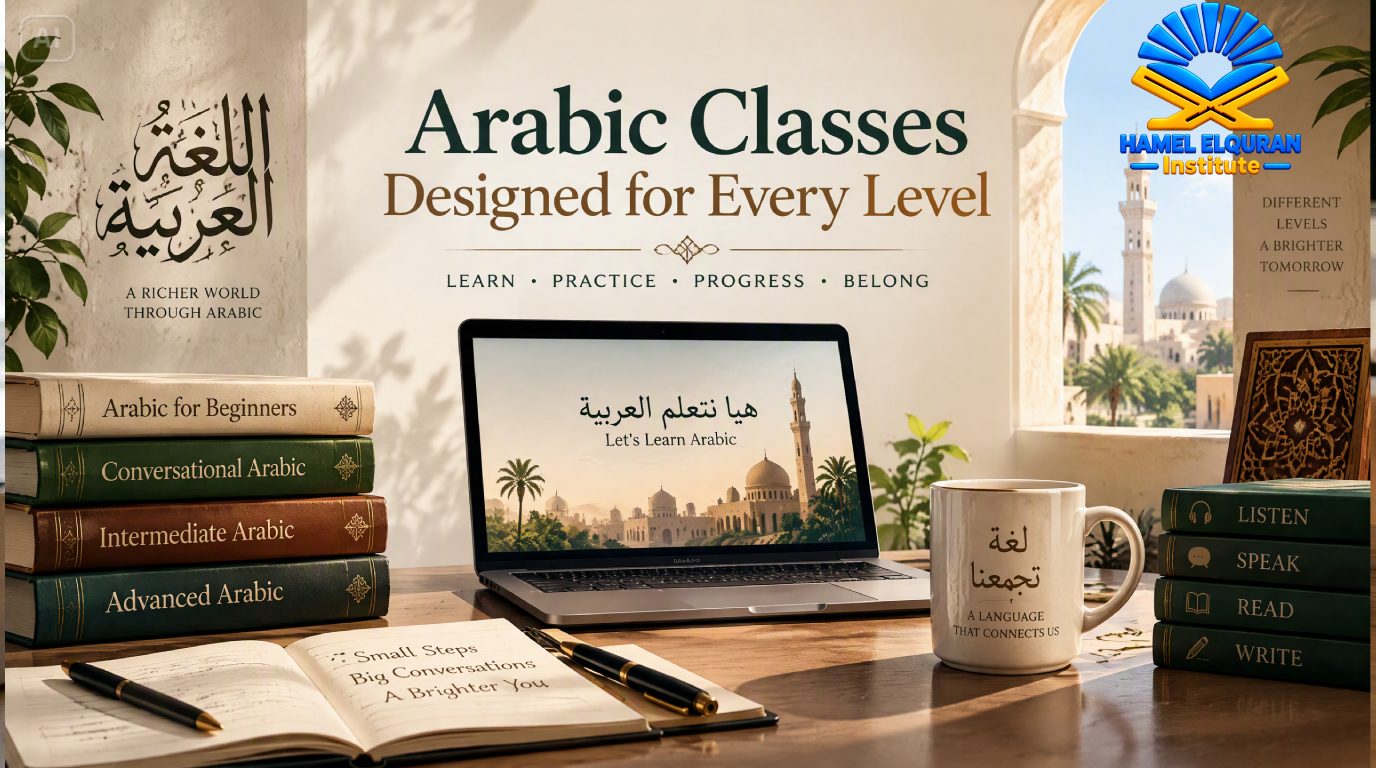
Arabic learning becomes more effective when lessons match the student’s existing skills. A beginner needs a different starting point from someone who can already read Arabic or hold a simple conversation.
Arabic for Beginners
Beginners usually start with the foundations of Arabic. This may include recognizing letters, learning their sounds, understanding how letters change when connected, and practicing short vowels.
As these skills develop, students can move toward reading simple words and sentences, building basic vocabulary, and understanding simple sentence patterns. Listening and speaking practice can also be introduced gradually.
The goal is not to rush through basic lessons. A strong foundation makes it easier to understand more advanced vocabulary, grammar, and reading material later.
Arabic for Kids
Children can learn Arabic through a gradual approach that matches their age and current ability. Early lessons may introduce letters, sounds, simple words, and familiar vocabulary before moving toward sentences and reading practice.
Children may also study Arabic vocabulary connected with the Quran. However, language learning should remain distinct from Tajweed and Quran recitation instruction. Each skill requires its own type of practice.
Arabic for Adults
Adults may begin Arabic for very different reasons. Some want to read Arabic, while others want to communicate, understand grammar, or study Quranic Arabic.
An adult learner who already knows the alphabet may not need to repeat basic letter lessons. Instead, the learning path can focus on the areas that need development, such as vocabulary, sentence formation, reading comprehension, grammar, or conversation.
Our Arabic Courses
A complete Arabic learning path can include several connected areas. The exact balance depends on the learner’s level and goals.
Arabic for Beginners
Beginner lessons can cover:
- Arabic letters and their sounds
- Letter forms and joining
- Short vowels
- Basic reading
- Common vocabulary
- Simple words and sentences
- Introductory grammar
- Basic listening and speaking practice
These skills provide the foundation for more advanced Arabic study.
Quranic Arabic
Quranic Arabic focuses on the language used in the Quran. Students may study recurring vocabulary, word meanings, basic grammar, sentence patterns, and expressions that appear throughout the Quran.
Learning this form of Arabic can help students recognize familiar words and understand how words function within Quranic sentences.
Quranic Arabic is different from Tajweed. Tajweed focuses on the correct rules of Quran recitation, while Quranic Arabic focuses on understanding the language. It is also different from Tafsir, which deals with the interpretation and explanation of Quranic meanings.
Arabic Grammar
Grammar helps learners understand how Arabic sentences are formed and how words relate to one another.
Lessons may introduce nouns, verbs, pronouns, sentence structures, and common grammatical patterns. Instead of treating grammar as a collection of isolated rules, students can apply each concept through words, sentences, reading, and practical examples.
This approach can be especially useful for learners who want to understand written Arabic or Quranic expressions more clearly.
Conversational Arabic
Conversational Arabic develops the ability to understand and produce spoken Arabic.
Students may practice introductions, questions and answers, everyday expressions, pronunciation, listening, and sentence formation. As their vocabulary increases, they can move from short responses to longer conversations.
The exact vocabulary and expressions can be selected according to the learner’s purpose and level.
Start Your Quran Learning Journey
Ready to improve your Quran reading and recitation with personalized guidance? Hamel El-Quran Academy offers one-to-one online Quran classes designed around your current reading level and learning goals.
Whether you are a beginner learning Arabic letters and Quran reading or an experienced reader looking to improve pronunciation and apply Tajweed rules correctly, our Quran teachers can listen to your recitation, identify mistakes, and guide you through practical correction. You can learn from home without traveling to a physical classroom, while receiving focused instruction and regular practice.
Start with a free trial Quran lesson to experience the teaching approach, interact with a Quran teacher, and receive initial feedback on your reading and recitation. Take the first step toward more accurate and confident Quran recitation today.

The Teacher’s Role in Online Arabic Classes
The teacher is an important part of the learning process. Online lessons should not simply provide students with information and leave them to work through it alone.
A teacher can first identify the learner’s current level and determine which skills need attention. During the lesson, the teacher can explain difficult concepts, listen to pronunciation, observe reading, correct mistakes, and provide opportunities for the student to practice.
For example, a learner may recognize Arabic letters but struggle to pronounce certain sounds. Another student may read accurately but have limited vocabulary. A more advanced learner may understand individual words but have difficulty applying grammar when reading a sentence. These students need different types of guidance.
The teacher can connect vocabulary to sentences, grammar to reading, and expressions to conversation. The teacher can also decide when a student needs more practice and when it is appropriate to introduce a more advanced skill.
This makes the teacher’s role more than simply explaining the lesson. The teacher can guide the student through practice and help determine what should come next.
How the Teacher Can Adapt the Lesson
Students do not always progress at the same pace. One learner may understand a new grammar concept quickly but need additional pronunciation practice. Another may read well but require more time to build speaking confidence. A flexible lesson can respond to these differences.
When a student needs reinforcement, the teacher can review previous material and provide additional examples. When the student demonstrates a strong understanding, the lesson can move toward more challenging reading, vocabulary, grammar, or conversation.
Children may also need shorter explanations and more repetition, while adults may benefit from direct explanations and practical examples. Beginners need a strong foundation, whereas experienced learners may need targeted practice in specific weak areas.
Adapting the lesson in this way helps keep learning connected to the student’s actual progress.
Choose the Right Arabic Learning Path
The right starting point depends largely on what the learner wants to achieve. Someone who wants to read Arabic needs strong letter recognition, pronunciation, vocabulary, and reading practice. A student focused on conversation needs more listening, speaking, sentence formation, and practical vocabulary.
A Quran-focused learner may want to prioritize Quranic vocabulary, grammar, reading, and recurring expressions.
Some learners have more than one goal. For example, a student may want to improve general Arabic while also developing the language skills needed to understand the Quran. Defining these goals helps determine which skills should receive the most attention.
What You Can Learn in an Arabic Course
A structured Arabic course can develop several connected skills, helping learners build stronger language abilities through reading, vocabulary, grammar, listening, and speaking practice.
- Reading: recognizing words and understanding written sentences
- Vocabulary: learning useful words and understanding them in context
- Grammar: understanding sentence structure and word relationships
- Listening: recognizing Arabic words and expressions when they are spoken
- Speaking: producing sentences and responding in Arabic
- Quranic Arabic: studying vocabulary and language patterns found in the Quran
Not every learner needs the same balance. A beginner may spend more time building foundational reading skills, while an advanced learner may need more conversation, comprehension, or grammar practice.
Build Arabic Skills Step by Step
Arabic learning usually develops through connected stages rather than isolated lessons. A beginner may start with letters and sounds, then move to connected letters, short words, and simple sentences. As reading becomes more comfortable, the learner can build vocabulary and study basic grammar.
Later, students can work with longer texts, more complex sentence structures, listening activities, and extended conversations.
For Quranic Arabic, the progression may include common Quranic vocabulary, basic grammatical patterns, and increasingly complex expressions.
Moving through these stages gradually gives students the opportunity to use earlier skills while learning new ones.
Arabic Reading and Vocabulary Practice
Reading and vocabulary are closely connected. Knowing individual words is useful, but learners also need to understand how those words work inside sentences.
For this reason, vocabulary practice can include words in context rather than lists of unrelated terms. Students can read short sentences, identify familiar words, and gradually understand how meaning changes according to the surrounding words.
Quran-focused learners can also study recurring Quranic vocabulary. Recognizing frequently used words can make familiar passages easier to approach, although understanding a complete verse may require attention to grammar, context, and interpretation.
From Grammar Rules to Real Understanding
Grammar becomes more useful when learners can apply it rather than simply memorize definitions.
A teacher can introduce a grammatical concept and then demonstrate it through words and sentences. Students can practice identifying the pattern, forming examples, and recognizing it during reading.
For learners studying Quranic Arabic, this can help explain how grammatical structures contribute to meaning. The objective is not to memorize rules separately from language use, but to understand how those rules operate in real Arabic.
Learn Arabic According to Your Goal
Different goals require different learning priorities. For students focused on reading Arabic, lessons can emphasize letters, pronunciation, word recognition, vocabulary, and reading fluency.
Those who want to improve their conversation skills can focus more on listening, pronunciation, sentence formation, everyday vocabulary, and speaking practice.
Learners interested in understanding Quranic Arabic may prioritize recurring vocabulary, grammar, sentence structures, and expressions found in the Quran.
These paths can also overlap. A learner can develop general Arabic skills while dedicating part of the learning plan to Quranic language.
How Our Online Arabic Lessons Work?
Online Arabic Classes can follow a clear learning cycle that helps students review, learn, practice, correct mistakes, and prepare for the next step.
- Review: The teacher checks previously learned material.
- New learning: A new skill, concept, vocabulary set, or reading material is introduced.
- Guided practice: The student applies the new material with teacher support.
- Correction: Mistakes in pronunciation, reading, grammar, or sentence formation are addressed.
- Review: The main points are reinforced before the lesson ends.
- Next step: The teacher identifies what the student should continue practicing.
The exact structure of Online Arabic Classes can change according to the student’s level and learning objective.
What Happens During a Typical Lesson?
A beginner in Online Arabic Classes may spend part of a lesson practicing letters, sounds, and simple reading. Another learner may work on vocabulary and sentence construction. An advanced student may spend more time reading, discussing topics, studying grammar, or practicing conversation.
The teacher can adjust the balance between explanation and practice according to the learner’s needs.
This makes the lesson more than a fixed sequence of information. Students have opportunities to apply what they learn and receive corrections while practicing.
Benefits of Learning Arabic Online
Online Arabic Classes give students the opportunity to study Arabic without traveling to a physical classroom.
This can be useful for children, adults, and families managing school, work, and other responsibilities. Students can also continue learning from home while maintaining a regular lesson schedule.
However, the online format itself does not determine the quality of learning. The teacher, curriculum, student participation, practice, and suitability of the learning path all matter.
A well-organized Online Arabic Classes program should give students a clear learning objective, direct practice, useful feedback, and a logical next step.
Practice Between Arabic Lessons
Regular practice between lessons helps reinforce what students learn during Online Arabic Classes. Depending on the learner’s goal, practice may include:
- Reviewing new vocabulary
- Reading previously studied words and sentences
- Practicing pronunciation aloud
- Listening to Arabic
- Writing simple sentences
- Reviewing grammar examples
- Recognizing familiar Quranic vocabulary
Practice does not need to be complicated. Consistency can help learners retain new material and return to the next lesson with stronger familiarity.
What Makes a Structured Arabic Learning Plan Useful?
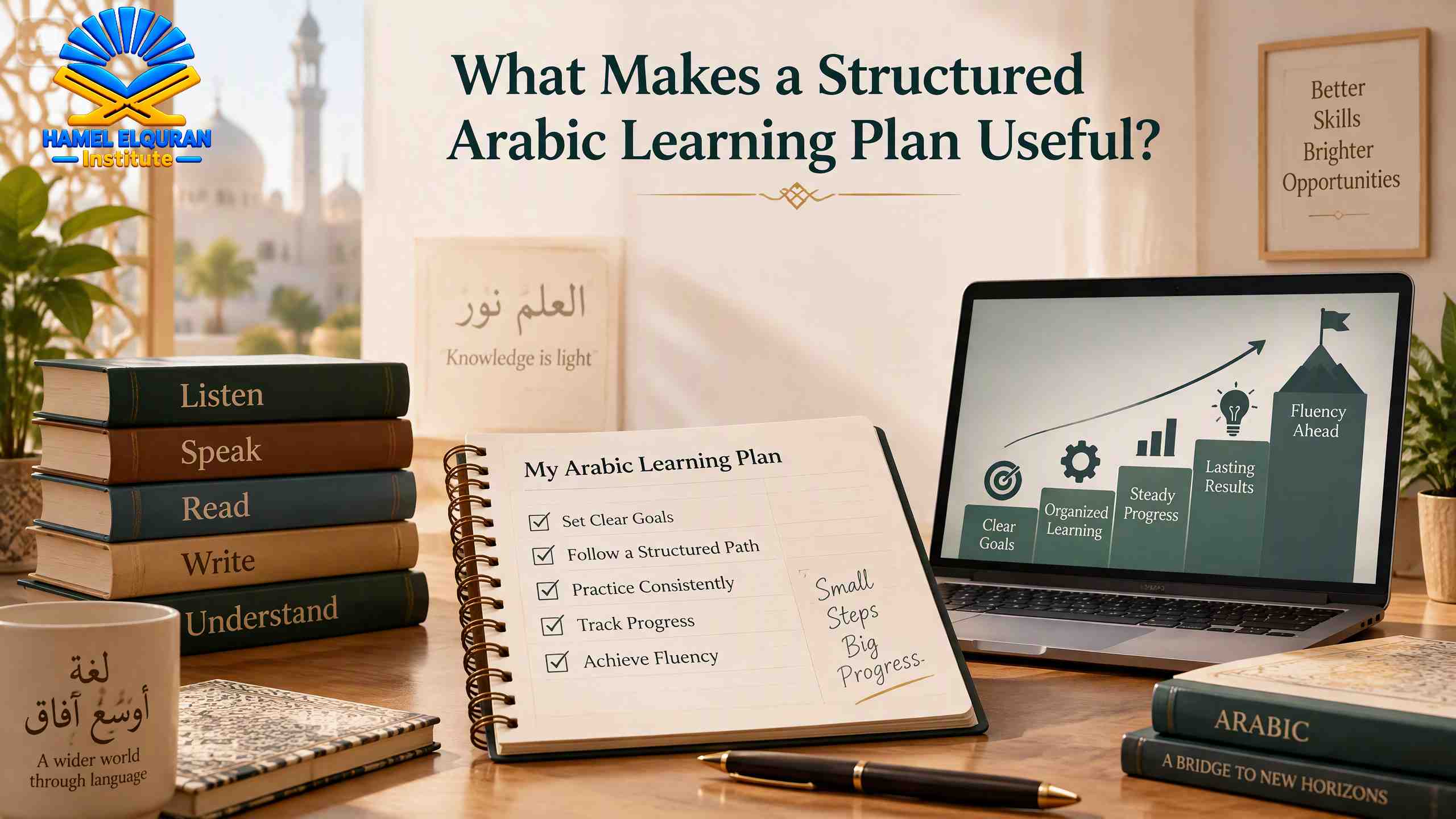
A structured learning plan gives students a clear direction. Instead of studying unrelated vocabulary or grammar topics, learners can progress from one skill to the next. Previous material can be reviewed while new concepts are introduced at an appropriate level.
For Online Arabic Classes, a useful plan should also allow adjustments. If a student needs more reading practice, that area can receive additional attention. If pronunciation is already strong, more time can be devoted to vocabulary, grammar, or conversation.
The purpose of structure is therefore not to make every learner follow exactly the same sequence. It is to create a logical path that can respond to individual progress.
When Should You Move to the Next Level?
Progress should be based on what the learner can actually do rather than simply the number of lessons completed.
A beginner may be ready to move forward when they can recognize letters, pronounce basic sounds, read simple words, and understand foundational vocabulary.
A more experienced learner may need to demonstrate stronger reading comprehension, grammar knowledge, vocabulary use, or conversational ability before moving to more advanced material.
For Quranic Arabic, progress may include recognizing common Quranic vocabulary, understanding basic grammatical structures, and identifying familiar expressions in context.
The teacher can use these abilities to determine which skills are ready for the next stage and which still need practice.
Who Can Learn Arabic With Us?
Online Arabic Classes can be suitable for students with different backgrounds and objectives, including:
- Complete beginners who are starting Arabic for the first time
- Children who need age-appropriate Arabic instruction
- Adults who want to develop reading, grammar, or speaking skills
- Quran learners who want to understand Quranic vocabulary and language
- Experienced learners who want to strengthen specific Arabic skills
For Online Arabic Classes, the important starting point is not age alone. Current ability and learning goals also help determine the most suitable path.
Arabic Learning for Quran Understanding
Arabic can play an important role in helping learners approach the Quran more directly. Studying Quranic vocabulary allows students to recognize recurring words. Grammar can help them understand relationships between words and sentence structures. Reading practice can make it easier to follow Arabic text.
At the same time, learning Arabic should not be presented as a replacement for Tafsir or other forms of Quranic explanation. Language knowledge can support understanding, while interpretation also depends on context and established scholarly explanations.
For this reason, Quranic Arabic can be treated as one part of a broader learning journey.
A Practical Starting Point for New Learners
The first step is to identify two things: the learner’s current Arabic ability and the main reason for studying Arabic.
A complete beginner may need to start with letters, sounds, pronunciation, and basic reading.
A learner who can already read may benefit more from vocabulary, grammar, comprehension, or conversation practice.
Someone interested in Quranic Arabic may prioritize recurring Quranic vocabulary, basic grammar, and understanding common expressions.
Starting at the appropriate level prevents unnecessary repetition and gives the learner a clearer path toward the skills they actually want to develop.
FAQ
Here are answers to common questions about Online Arabic Classes, levels, courses, and learning goals.
Can beginners join Online Arabic Classes?
Yes. Beginners can start with foundational skills such as Arabic letters, pronunciation, vowels, basic vocabulary, and simple reading. The learning path can then progress toward sentences, grammar, listening, and speaking as their skills develop.
Can I learn Arabic to understand the Quran?
Yes. Quranic Arabic can focus on vocabulary, grammar, sentence structures, and expressions commonly found in the Quran. It can support language-based understanding while remaining distinct from Tafsir and Tajweed.
Are the classes suitable for children and adults?
Yes. Children and adults can follow different learning approaches based on age, current ability, and goals. Children may need gradual instruction and repetition, while adults may have more specific objectives such as reading, conversation, grammar, or Quranic Arabic.
Should I study Quranic Arabic or conversational Arabic?
It depends on your goal. Quranic Arabic focuses on the language of the Quran, while conversational Arabic emphasizes listening and speaking in everyday situations. Learners with multiple goals can combine elements of both.
In conclusion, learning Arabic becomes easier to organize when you know where you are starting and what you want to achieve.
A beginner may need to build reading and pronunciation skills first. A student who already reads Arabic may need vocabulary, grammar, or conversation practice. A Quran-focused learner may want to give greater attention to Quranic vocabulary and language patterns.
Hamel El-Quran Academy provides an Arabic learning approach that can accommodate these different goals while keeping Quran-related learning in context.
The next step is to identify your current level, define your main objective, and follow a learning path that matches those needs. With regular lessons, active practice, and teacher guidance, Arabic learning can develop progressively from foundational skills toward greater reading, comprehension, and communication.