
Learning Arabic letters for beginners can feel like opening a mysterious book filled with unfamiliar shapes, tiny dots, and sounds that seem impossible to pronounce.
For nine-year-old Omar, that mysterious book was sitting on his bedroom desk, waiting for him to discover something wonderful.
Every evening, he listened to his father recite the Quran after Maghrib prayer, and although he couldn’t understand every Arabic word, he loved the peaceful sound of the recitation.
There was just one problem that Omar had never told anyone about: he desperately wanted to read the Quran himself, but he didn’t know where to begin.
He had tried looking at Arabic letters before, yet they always seemed to dance across the page like strange little symbols.
What Omar didn’t realize was that one rainy evening, three simple letters and a few unexpected discoveries were about to change everything.

Why Learning Arabic Letters Felt Difficult for Omar
Learning Arabic letters seemed challenging to Omar at first, but his journey began with curiosity, determination, and his father’s encouragement.
Omar’s First Struggle with Arabic Letters
Rain tapped gently against Omar’s bedroom window as he sat at his wooden desk, staring at the Arabic reading book his father had given him.
He opened the first page and ran his finger beneath the unfamiliar letters, hoping that something would suddenly begin to make sense.
Some letters looked like tiny boats, others had dots floating above them, and several appeared almost identical except for one small detail.
Omar leaned closer, studying the shapes with the same determination he usually reserved for solving difficult puzzles at school.
“Why can’t I understand any of this?” he whispered, feeling frustrated that something so important to him seemed so far away.
Omar Shares His Frustration with His Father
Just then, his father appeared at the bedroom door and noticed the open book beside Omar’s disappointed expression.
“What’s wrong, Omar?” he asked, pulling up a chair and sitting beside him without rushing to offer an explanation.
“I want to read the Quran like you do,” Omar admitted, “but I don’t even know what these letters mean.”
His father looked at the page for a moment before asking a question that Omar hadn’t expected to hear.

A Valuable Lesson About Learning Step by Step
“Do you remember the first time you learned to ride your bicycle, and how impossible balancing seemed before you practiced?”
Omar nodded, remembering the scraped knees, the wobbling handlebars, and the afternoon he had finally managed to ride without help.
“Learning Arabic works in a similar way,” his father explained, “because you begin with small skills before putting everything together.”
Omar looked at the book again, wondering whether those confusing shapes could really become as familiar as riding his bicycle.
A Simple Plan to Begin Learning Arabic
“Tomorrow morning, we’ll start with only three letters,” his father promised, closing the book gently and placing it beside Omar’s notebook.
“Only three?” Omar asked, surprised that his father wasn’t planning to teach him the entire alphabet at once.
“Only three,” his father replied, “because understanding a few letters properly is better than rushing through twenty-eight without remembering them.”
For the first time that evening, Omar felt a little hopeful, and he went to sleep wondering what those first three letters might be.
How Omar Learned His First Three Arabic Letters
The following morning, Omar hurried downstairs and discovered three small cards arranged neatly beside his breakfast plate.
His father was already waiting at the table, holding a pencil and smiling as though he had prepared a special surprise.
“Today, you’re going to meet three Arabic letters,” he announced, placing the first card directly in front of Omar.
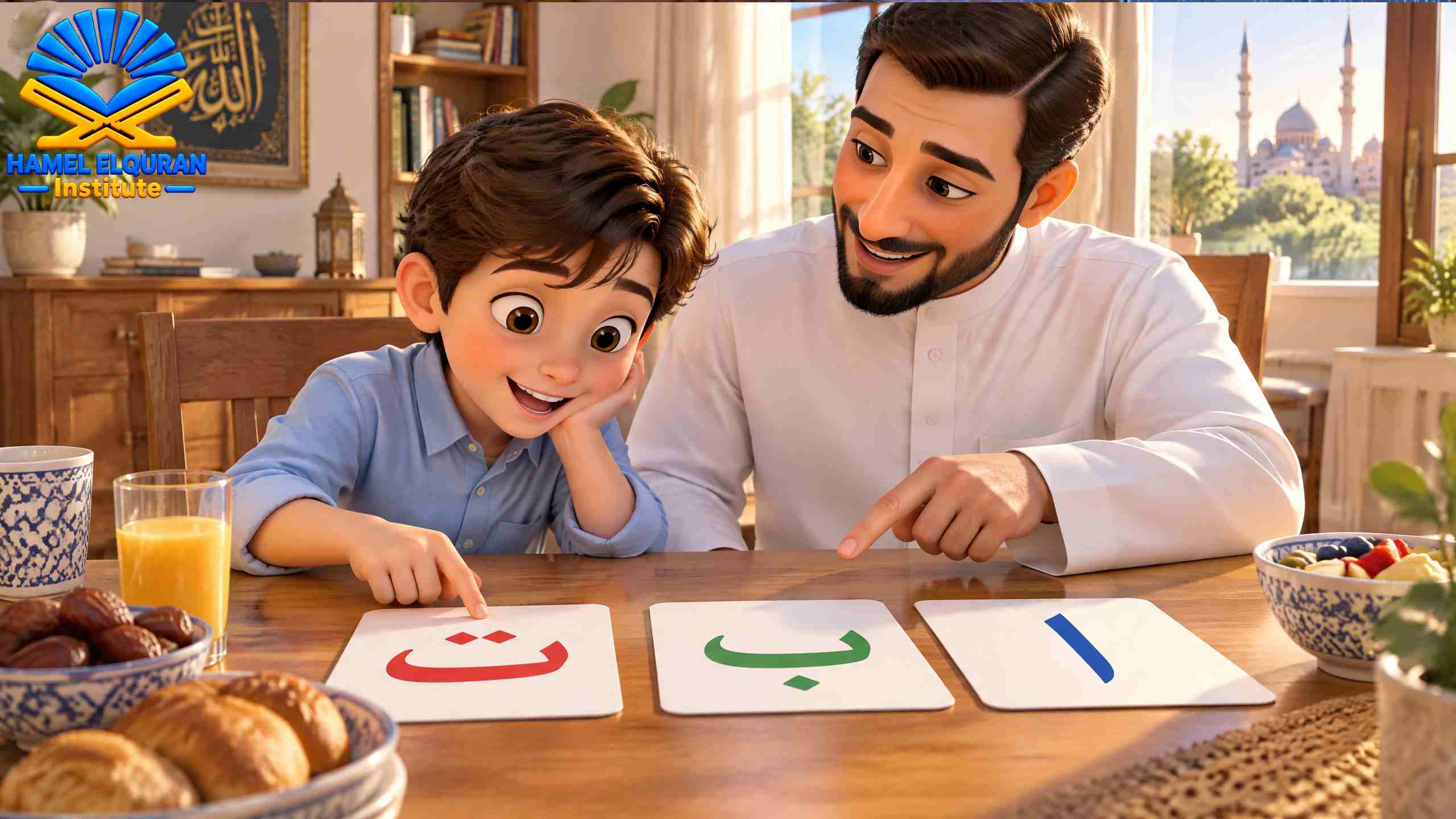
ا — Alif
Omar tilted his head and studied the shape, surprised that it looked much simpler than the complicated letters he remembered.
“It looks like a straight line!” he exclaimed, tracing the shape in the air with his finger.
“That’s Alif,” his father explained, “and it’s the first letter of the Arabic alphabet, which contains twenty-eight basic letters.”
He added that Alif has several important roles in Arabic writing, including helping represent long vowel sounds in certain situations.
Omar copied the letter into his notebook, carefully drawing the straight line before looking up for his next challenge.
His father placed another card beside the first, revealing a curved shape with one small dot underneath it.
ب — Baa
“This is Baa,” he explained, “and its consonant sound is similar to the English letter B in the word book.”
Omar brought his lips together and repeated the sound several times, enjoying how easily he could recognize the new letter.
Baa or Taa? The Mystery of the Dots
Then his father revealed the third card, and Omar immediately frowned because something about it seemed strangely familiar.
ت — Taa
“Wait a minute!” Omar protested, pointing between the two cards. “That looks almost exactly like the letter we just learned!”
His father smiled and asked him to examine both shapes carefully, paying particular attention to the small marks around them.
Omar leaned forward, studying the cards until his eyes suddenly widened with excitement at a detail he had almost missed.
“Baa has one dot underneath, but Taa has two dots above!” he announced, feeling as though he had solved a mystery.
“Exactly,” his father replied, “and those dots help us distinguish letters that share similar shapes but represent different sounds.”
He explained that Taa has a consonant sound similar to the English T, although careful listening helps learners develop accurate Arabic pronunciation.
Omar arranged his three cards in a neat row and proudly read their names without asking his father for help.
ا — ب — ت
Yesterday, the Arabic alphabet had seemed like an impossible puzzle, but today Omar could recognize three pieces of it.
A Simple Exercise to Recognize Arabic Letters
Before putting the cards away, Omar’s father suggested a small game to help him remember the letters more confidently.
He mixed the cards together and asked Omar to identify each letter by looking at its shape and the position of its dots.
Next, Omar copied each letter five times into his notebook, saying its name aloud while paying attention to its written form.
Finally, his father named Baa or Taa without showing the cards, and Omar selected the correct letter from the table.
This exercise helped him connect the appearance of each letter with its name and sound rather than memorizing shapes without understanding them.
If you’re beginning your own Arabic learning journey, try this exercise with three letters before gradually introducing more unfamiliar shapes.
Understanding Arabic Harakat: Fatha, Kasra, and Damma
A few mornings later, Omar was feeling confident enough to recognize several Arabic letters without looking at his notebook.
But when his father opened a beginner’s reading book, Omar noticed something that made him question everything he had learned.
The letter Baa appeared three times on the page, yet each example seemed to have a different pronunciation.
“Did someone make a mistake when printing this book?” Omar asked, pointing at the tiny marks surrounding the letters.
His father chuckled and explained that those marks were actually an important part of learning how to read vowelled Arabic.
“They’re called Harakat,” he said, “and they help us understand the short vowel sounds that accompany Arabic consonants.”
He took Omar’s pencil and wrote three examples in large, clear handwriting across the top of a fresh page.

Fatha: The Short A Sound
بَ — Ba
His father pointed to the small diagonal mark above Baa and explained that it was called Fatha.
“When you see Fatha above a consonant, you pronounce that consonant with a short vowel sound similar to the A in cat.”
Omar repeated the sound carefully, making sure that he didn’t stretch the vowel longer than his father had demonstrated.
Kasra: The Short I Sound
بِ — Bi
Next, his father drew a small diagonal mark underneath Baa and explained that this mark was called Kasra.
“Kasra gives the consonant a short vowel sound similar to the I in sit,” he explained, demonstrating the pronunciation slowly.
Omar repeated the sound several times, noticing how moving the vowel mark changed the syllable even though the consonant remained the same.
Damma: The Short U Sound
بُ — Bu
Finally, his father showed him a small curl above the letter and explained that this mark was called Damma.
“Damma produces a short rounded vowel sound, approximately like the vowel in put, although you should listen to an Arabic speaker for accuracy.”
Omar looked at the three examples again and suddenly realized that he had discovered something much more useful than another letter.
“So the letter stays the same, but the little marks tell me how to pronounce it?” he asked excitedly.
“Exactly,” his father answered, “and once you understand these vowel marks, you can begin reading many simple Arabic syllables.”
Together, they practiced the three combinations until Omar could recognize and pronounce each one without hesitation.
بَ — بِ — بُ
Then his father introduced the same marks with Taa, showing Omar that the pattern worked with other consonants too.
تَ — تِ — تُ
Omar smiled when he realized that he could now read six short syllables using only two consonants and three vowel marks.
Practice Arabic Short Vowels with Omar
Choose a familiar consonant such as Baa, write it three times, and add Fatha, Kasra, and Damma to create different syllables.
Read each example slowly while listening to a reliable Arabic pronunciation recording, paying attention to the difference between the three vowel sounds.
Next, repeat the exercise with Taa or another consonant you already know, making sure that you don’t confuse short vowels with long vowels.
Omar discovered that practicing a few accurate sounds each day was far more helpful than rushing through an entire page without understanding it.
How Arabic Letters Change Shape When Connected
One Saturday afternoon, Omar proudly announced that he was ready to recognize Arabic letters wherever they appeared in his reading book.
His father smiled, opened a page containing simple Arabic words, and asked him to identify any letters he already knew.
Omar leaned forward confidently, but his smile quickly disappeared when he noticed that the familiar shapes seemed to have changed.
“Those aren’t the same letters!” he complained, wondering whether his father had secretly introduced an entirely new alphabet.
His father explained that Arabic is written from right to left and that many letters connect to their neighbors inside words.
He also explained that some letters change their written appearance depending on their position within a connected sequence.
To make the idea easier to understand, he wrote four different forms of Baa across Omar’s notebook.
ب — بـ — ـبـ — ـب
“These are all forms of Baa,” he explained, “but their shapes change depending on how they connect with surrounding letters.”
Omar studied the examples carefully and noticed that the familiar dot remained underneath each form, helping him recognize the letter.
“So it’s still Baa, even when it looks different?” he asked, tracing the shapes with his pencil.
“Exactly,” his father replied, “and learning these connected forms will help you recognize letters when they appear inside complete Arabic words.”
Omar practiced writing the four forms, gradually understanding that the alphabet wasn’t changing into something new after all.
Recognizing Arabic Letters in Different Positions
His father explained that many Arabic letters have isolated, initial, medial, and final forms, although their appearance depends on surrounding connections.
He also introduced six letters that do not connect to the letter immediately following them in the normal direction of Arabic writing.
ا — د — ذ — ر — ز — و
“These letters can connect to a preceding letter when appropriate, but they don’t connect forward to the next letter,” his father explained.
Omar found this surprising because he had assumed that every Arabic letter would connect to its neighbors in exactly the same way.
His father reminded him that understanding these patterns would become easier through reading practice rather than memorizing every possible shape immediately.
Then he wrote a short Arabic word containing a familiar consonant and a long vowel, asking Omar to look carefully.
بَاب — Baab — Door
Omar recognized Baa at the beginning and end, while his father explained that the Alif represented a long vowel after the first Baa.
“Listen carefully,” his father said, pronouncing the word slowly so Omar could hear the longer vowel sound.
Omar repeated the word, stretching the vowel gently and smiling when his father confirmed that he had pronounced it correctly.
For the first time, Omar understood that reading Arabic involved recognizing letters, understanding connections, and interpreting vowel sounds together.
Reading Simple Arabic Words for the First Time
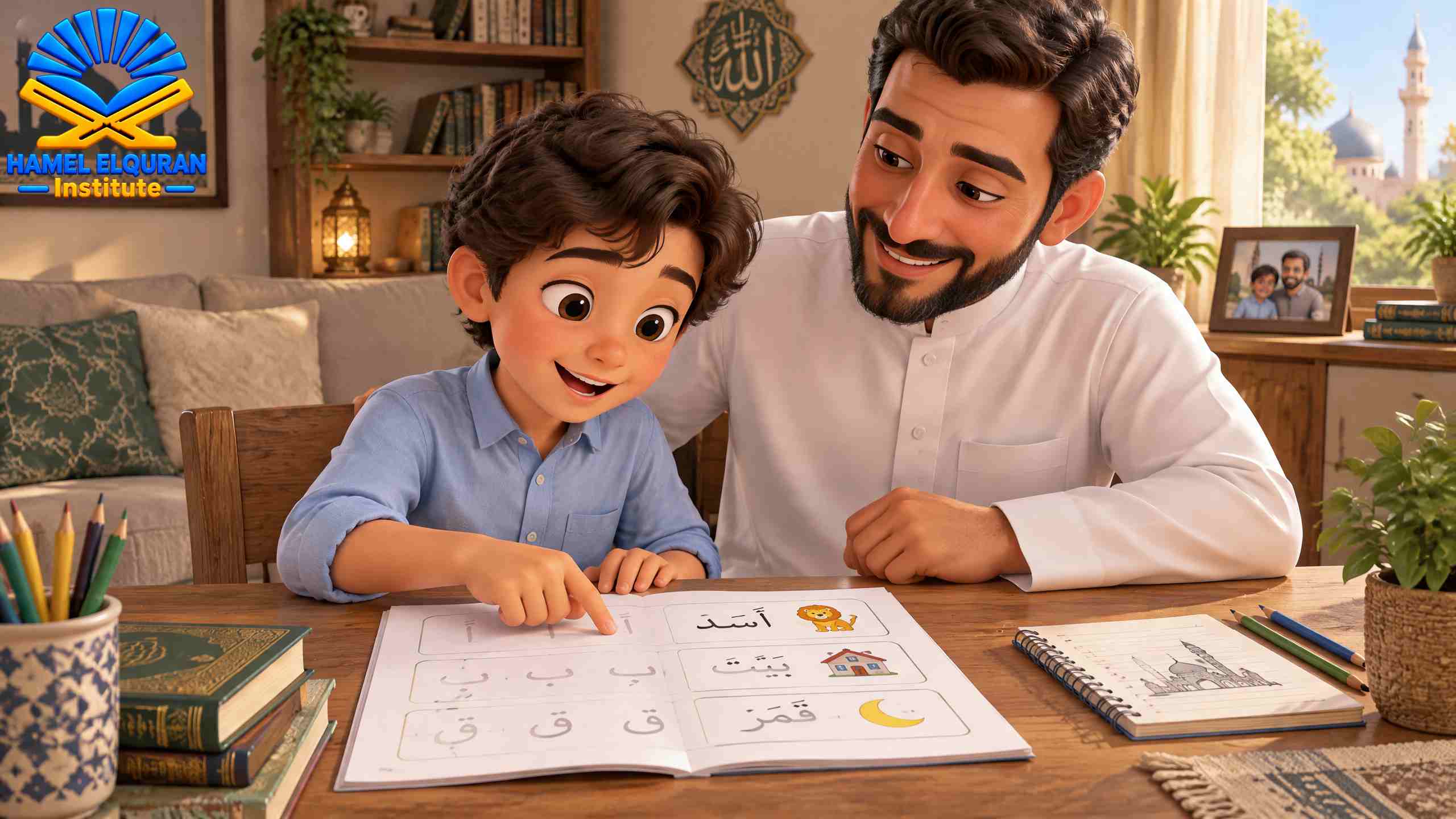
After two weeks of short, regular lessons, Omar’s father prepared a special reading sheet containing several simple Arabic words.
Omar expected another alphabet exercise, but this time the page looked different because the letters formed complete words.
His father placed the sheet on the table and asked him to read the first example without rushing.
بَاب — Baab — Door
Omar examined the letters carefully, remembering that the Alif lengthened the preceding vowel rather than adding another short syllable.
He pronounced the word slowly, and his father nodded approvingly before pointing to the next example.
بَابَا — Baabaa — Dad (informal)
Omar recognized the repeated pattern and read the word in two syllables, feeling more confident because he understood how the letters worked together.
Then his father wrote another example, explaining that it contained a new consonant they had recently practiced.
كَتَبَ — Kataba — He wrote
Omar studied the three consonants and their Fatha marks before pronouncing each short syllable carefully and clearly.
His father explained that Arabic words often follow recognizable patterns, which become easier to notice as reading experience grows.
Omar looked down at the page and realized that he was no longer simply naming letters because he was beginning to read meaningful words.
He still needed help with unfamiliar sounds, but the experience made him eager to discover what he could read next.
“Does that mean I’m ready to read the whole Quran?” he asked, looking at his father with hopeful eyes.
His father smiled and explained that reading Quranic Arabic accurately required additional practice with vowel marks, pronunciation, and recitation rules.
“You’re building the foundation,” he told Omar, “and every word you learn makes the next step a little easier.”
Instead of feeling disappointed, Omar understood that his progress was real, even though he still had many important skills to develop.
Why Correct Arabic Pronunciation Matters for Quran Reading
One evening, Omar sat beside his father during Quran practice and tried repeating a short passage he had heard many times.
He recognized several familiar letters, but when he encountered an unfamiliar throat sound, he hurried through it rather than asking for help.
His father gently stopped him and wrote two Arabic letters on a small piece of paper.
ه — Haa
ح — Haa (a different throat sound)
Omar stared at the letters, wondering why two sounds that seemed so similar needed to be represented by different symbols.
His father explained that Arabic contains several sounds that may be unfamiliar to English speakers, particularly sounds produced in different parts of the throat.
He demonstrated that ه is articulated from the deeper throat region, while ح is articulated from the middle throat.
Omar tried repeating both sounds, but he quickly discovered that recognizing the written difference was easier than producing the correct pronunciation.
“Why does it matter so much?” he asked, feeling slightly embarrassed that he couldn’t pronounce both letters correctly.
His father explained that each Arabic letter has its own sound and articulation characteristics, which should be preserved when reading the Quran.
He also introduced Omar to the idea of Tajweed, explaining that it involves learning the rules and pronunciation principles used in Quran recitation.
“Learning the alphabet helps you recognize what you’re reading,” he explained, “while studying Tajweed helps you recite the Quran more accurately.”
Omar practiced the sounds slowly, listening to his father’s demonstration and allowing himself to make mistakes without becoming discouraged.
He discovered that correct pronunciation was not something he could always learn from written explanations alone, especially with unfamiliar Arabic sounds.
That evening, Omar decided that asking questions and accepting correction were signs of progress rather than reasons to feel embarrassed.
How Omar Became More Confident Reading Arabic
Several weeks later, Omar returned to the same bedroom desk where he had once stared helplessly at his Arabic reading book.
His little notebook was now filled with handwritten letters, vowel marks, connected forms, simple words, and corrections from his father.
He opened the first page and smiled when he saw the three letters that had started his entire journey.
ا — ب — ت
He remembered how impossible the alphabet had seemed on that rainy evening, when every unfamiliar shape had made him feel discouraged.
Now he could recognize more letters, distinguish several short vowels, and read simple practice words with increasing confidence.
He still made mistakes, especially when unfamiliar letters appeared together, but those mistakes no longer made him want to close the book.
His father entered the room and asked whether Omar wanted to practice another short passage before going to bed.
Omar nodded eagerly, opened his reading book, and began sounding out the letters while his father listened and corrected him when necessary.
Some words were still difficult, and he occasionally needed help remembering a vowel sound or recognizing a connected letter.
But something important had changed: Omar no longer saw Arabic as an impossible collection of mysterious shapes.
He understood that learning to read was a gradual process, and that every small improvement brought him closer to his goal.
That night, he placed his notebook beside the Quran reading book and smiled at the thought of what he might learn tomorrow.
How to Learn Arabic Letters for Beginners Step by Step
Omar’s experience shows that learning Arabic letters for beginners becomes more manageable when lessons are divided into small, meaningful steps.
Start by recognizing a few letters and connecting each written shape with its correct name and consonant sound.
Once those letters feel familiar, practice Fatha, Kasra, and Damma so you can begin reading simple vowelled syllables.
Next, learn how letters change their written forms inside words, paying attention to their connections and the position of their dots.
When you’re comfortable with these foundations, begin reading carefully selected Arabic words before progressing toward longer reading passages.
Listening to accurate pronunciation is particularly important because written explanations cannot fully demonstrate every Arabic sound or articulation point.
Most importantly, remember that consistent practice is more useful than occasional long sessions that leave you tired, frustrated, or confused.
A Simple 7-Day Arabic Alphabet Practice Plan
This simple seven-day plan helps beginners learn Arabic letters gradually through daily practice, building confidence and improving recognition skills.
Day 1: Discover Your First Three Letters
Begin with Alif, Baa, and Taa, learning their basic shapes and practicing how to recognize them without looking at an alphabet chart.
Day 2: Learn Three More Arabic Letters
Review your first three letters before introducing Thaa, Jeem, and Haa (ح), listening carefully to their pronunciation and practicing their written forms.
Day 3: Practice Arabic Short Vowels
Study Fatha, Kasra, and Damma with familiar consonants, reading short syllables aloud and checking your pronunciation against reliable examples.
Building Confidence Through Arabic Letter Review and Practice

Day 4: Review and Recognize Arabic Letters
Spend time reviewing the letters and vowel marks you’ve already learned, focusing on recognizing each shape without relying on your notes.
Try mixing your flashcards and identifying the letters in a different order, just as Omar practiced with his father during their first lessons.
Day 5: Understand How Arabic Letters Connect
Practice writing Baa and Taa in their isolated, initial, medial, and final forms, observing how their shapes change when connected to other letters.
Remember that Arabic is written from right to left, and pay attention to the dots that help distinguish similar-looking letters.
Day 6: Read Your First Simple Arabic Words
Choose a few fully vowelled Arabic words that contain familiar letters, then practice reading each one slowly before checking your pronunciation.
Begin with examples such as بَاب (Baab) and كَتَبَ (Kataba), remembering the difference between short and long vowel sounds.
Day 7: Review Your Progress and Celebrate Small Achievements
Return to the letters and words you studied throughout the week, identifying which sounds or shapes still require additional practice.
You might not recognize every Arabic letter after seven days, but you’ll have started building the skills needed for future Quran reading lessons.
This plan is a flexible starting point rather than a strict deadline, so repeat any lesson whenever you need more time.
Frequently Asked Questions About Learning Arabic Letters
Let’s explore the essential steps that will help you develop your Arabic reading skills, improve pronunciation, and build confidence gradually.
How Many Letters Are in the Arabic Alphabet?
The Arabic alphabet contains twenty-eight basic letters, each with its own identity and pronunciation characteristics that learners gradually become familiar with.
Some letters share similar shapes and are distinguished by their dots, while others have sounds that may be unfamiliar to English speakers.
Learning these letters is an important foundation for reading Arabic words and eventually developing the skills needed for Quran recitation.
Is It Difficult to Learn Arabic Letters for Beginners?
Learning Arabic letters can initially feel challenging because the writing system differs from English in its direction, connected forms, and pronunciation patterns.
However, beginners can make steady progress by studying small groups of letters and practicing their shapes and sounds consistently.
Omar’s experience illustrates how a confusing alphabet can gradually become more familiar when learners focus on understanding rather than memorizing everything immediately.
How Long Does It Take to Learn the Arabic Alphabet?
The time needed to learn Arabic letters varies depending on your previous language experience, learning methods, and the amount of practice you complete.
Some learners recognize all twenty-eight letters within a few weeks, while others need more time to master pronunciation and connected forms.
Recognizing the alphabet is also different from reading Arabic fluently, because reading requires additional knowledge of vowels, letter connections, and word patterns.
Rather than worrying about a specific deadline, focus on making consistent progress and developing accurate reading habits from the beginning.
Conclusion
That night, Omar opened his little blue notebook and smiled as he remembered how his Arabic learning journey had begun.
He knew that learning to read the Quran correctly would require patience, regular practice, and the courage to face challenges.
However, he had discovered that every small step, every new letter, and every mistake helped him grow more confident.
Remember, you don’t need to learn everything at once, because the letter you practice today could help you read a Quranic verse tomorrow.