

Quran recitation classes online can help learners improve their pronunciation, understand Tajweed rules, and develop a consistent Quran reading routine. Whether you are a beginner learning to read Arabic or someone who already reads the Quran but wants to refine their recitation, the right learning approach can make practice more structured and productive.
The most suitable classes depend on your current reading level, learning goals, and the areas you need to improve. Some learners need help recognizing Arabic letters and connecting them correctly, while others want to correct pronunciation, apply Tajweed rules, or strengthen their fluency.
Understanding what online Quran recitation lessons should include can help you choose a learning path that matches your needs. It can also help you compare available learning options and identify the skills you should focus on first.
What Do Online Quran Recitation Classes Teach?

Online Quran recitation classes focus on helping learners read the Quran more accurately and confidently. The specific lessons depend on the learner’s current ability and the skills they want to develop.
Common learning areas include:
- Arabic letter recognition: Identifying Arabic letters and distinguishing between letters with similar shapes or sounds.
- Correct pronunciation: Learning how to pronounce Arabic letters clearly and recognize their articulation points.
- Tajweed rules: Understanding the rules that guide Quran recitation and learning how to apply them during reading.
- Reading fluency: Connecting words and verses more smoothly without sacrificing accuracy.
- Regular revision: Reviewing previously learned material to reinforce correct pronunciation and reading habits.
Beginners may need to establish a foundation in Arabic reading before studying more advanced recitation rules. Learners with previous experience may benefit from focusing on specific pronunciation errors, Tajweed applications, or areas where their reading becomes less fluent.
The goal is to develop accurate recitation through structured learning and consistent practice rather than simply reading more verses without reviewing mistakes.
Who Can Benefit from Online Quran Recitation Lessons?
Online Quran recitation lessons can support learners at different stages. Identifying your starting point helps you choose lessons that address your actual needs.
Beginners learning Arabic reading
Learners who cannot yet read Arabic fluently may need to start with letter recognition, vowel marks, and the correct pronunciation of basic sounds. Building these skills first makes it easier to progress toward reading Quranic words and verses.
Learners who can read but need pronunciation correction
Some learners recognize Arabic words but struggle with specific letters or sounds. Guided practice can help them identify these difficulties and work on correcting them gradually.
Learners studying Tajweed
Those who already read the Quran may want to improve their understanding of Tajweed rules and apply them more consistently. Their lessons can focus on rules that affect their recitation and need further practice.
Children learning Quran recitation
Children often benefit from age-appropriate explanations, manageable lesson goals, and regular opportunities to practise. Parents can explore quran classes for kids to learn more about options designed for younger learners.
Adults returning to Quran study
Adults who have not practised for some time may want to refresh their Arabic reading skills, revisit Tajweed principles, or establish a regular recitation routine. Online learning can provide a way to explore lessons around their learning needs and availability.
What Should You Look for in Quran Recitation Classes Online?
Choosing classes involves more than comparing lesson formats. You should consider whether the learning approach addresses your current difficulties and gives you a clear way to work toward your goals.
A Learning Path That Matches Your Level
The lessons should reflect what you can already do. A beginner may need to practise letters and vowel marks, while an experienced reader may need to focus on pronunciation, fluency, or specific Tajweed rules.
Starting at the appropriate level helps you avoid lessons that are either too difficult or unnecessarily basic.
Clear Pronunciation Guidance
Accurate recitation depends on producing Arabic sounds correctly. Look for a learning approach that gives attention to articulation points, similar-sounding letters, and common pronunciation mistakes.
When a learner understands what needs correcting, practice becomes more focused and purposeful.
Tajweed Explained Through Practice
Knowing the definition of a Tajweed rule is not the same as applying it during recitation. Effective learning connects explanations with examples and opportunities to practise reading Quranic passages.
This allows learners to understand how the rules work in context instead of memorizing information without applying it.
Opportunities to Review Progress
Progress is easier to recognize when learners revisit earlier material and identify areas that still need attention. Regular review can help reveal whether pronunciation is becoming more consistent and whether previously learned rules are being applied correctly.
Before enrolling, ask how the learning process is organized and what kind of guidance is available for your level and goals.
How Does Tajweed Improve Quran Recitation?
Tajweed provides rules for reciting the Quran correctly. Learning these rules helps readers understand how Arabic letters and sounds should be pronounced and how particular recitation patterns should be applied.
Important areas include:
- Makharij al-huruf: The articulation points from which Arabic letters are produced.
- Sifat al-huruf: The characteristics that distinguish the sounds of Arabic letters.
- Rules of noon sakinah and tanween: Rules that govern how these forms are pronounced in different contexts.
- Rules of meem sakinah: Guidance for pronouncing meem sakinah according to its surrounding letters.
- Madd: Rules concerning the lengthening of specific sounds during recitation.
- Waqf and ibtida: Principles related to stopping and resuming recitation.
Learners do not necessarily need to study every rule at once. Their starting level and current difficulties should determine which concepts receive attention first. Taking quran tajweed classes can help learners recognize pronunciation rules and apply them more accurately during Quran recitation.
For example, a learner who confuses two Arabic letters may need to practise their articulation before concentrating on more complex rules. Another learner may pronounce letters clearly but need more practice applying madd or identifying appropriate stopping points.
A gradual approach helps connect theoretical knowledge with actual recitation. For a broader overview of available learning options, explore al quran classes.
How to Choose the Right Online Quran Recitation Course
The right course should fit your reading ability, learning priorities, and practical circumstances. Comparing these factors can help you make a more informed decision.
Identify Your Main Learning Goal
Begin by deciding what you want to improve. Your goal might be to learn Arabic letters, correct pronunciation, study Tajweed, improve reading fluency, or strengthen your overall recitation.
A clear goal makes it easier to identify whether a course addresses the skills you need.
Check the Lesson Structure
Review how lessons are organized and whether the learning approach suits your level. Ask whether the course covers foundational reading, pronunciation, Tajweed, or a combination of these areas.
You should also understand how lesson expectations and practice requirements are communicated.
Consider the Learning Format
Online Quran lessons may use different formats depending on the provider. Before choosing, check the available arrangements, how learners participate, and whether the format fits your preferences and schedule.
Learners in the United States can also review online quran classes USA when exploring options relevant to their location.
Compare the Available Learning Options
Do not base your decision on promotional language alone. Compare course content, teaching approach, learning expectations, and the type of guidance provided.
Exploring the best online quran classes can help you evaluate different options according to your priorities rather than relying on a single factor.
Ask How Your Progress Will Be Reviewed
Before starting, find out how you can identify mistakes, revisit difficult material, and decide what to practise next. Clear learning goals and regular review can make it easier to recognize areas of improvement.
Improve Your Quran Recitation with Hamel El-Quran Academy
Looking for Quran recitation classes online to improve your pronunciation, strengthen your reading skills, and apply Tajweed rules more accurately? Hamel El-Quran Academy offers online Quran learning options for learners with different levels and goals.
Whether you are beginning to read Arabic or want to refine your existing recitation, identifying your learning needs can help you choose the right next step. Explore the available learning options at Hamel El-Quran Academy and find a learning path that supports your Quran recitation goals.

How to Practise Quran Recitation Between Lessons?
Regular practice helps reinforce what you learn during lessons. A manageable routine is often more useful than occasional long sessions that are difficult to maintain.
Use these methods to make practice more focused and productive through structured online quran classes.
Practise a Short Passage Carefully
Choose a short passage that matches your current level. Read it slowly and focus on producing each letter clearly before trying to increase your pace.
Accuracy should remain the priority. Reading quickly while repeating the same mistakes can make them harder to recognize and correct.
Focus on One or Two Skills at a Time
Instead of trying to correct every difficulty in one session, select a specific target. You might focus on a particular letter, one Tajweed rule, or the smooth connection between words.
Once that skill becomes more consistent, move to another area that needs attention.
Listen and Follow Along
Listening to a reliable Quran recitation can help you become more familiar with pronunciation, rhythm, and the application of Tajweed rules. Follow along with the written text and pay attention to the sounds or rules you are currently studying.
Listening supports learning, but it does not replace practising the recitation yourself.
Keep a Record of Difficulties
Write down the letters, words, or rules that you find challenging. Return to these points during your next practice session instead of repeating only the parts you already know well.
You can also note which areas have become easier over time. This helps you focus your efforts and prepare specific questions for your lessons.
Review Previously Learned Material
Revisiting familiar passages helps reinforce correct reading habits. Include earlier material in your routine, even when your main goal is to learn something new.
The amount of practice will depend on your schedule and ability. Consistency and careful correction are more important than setting an unrealistic daily target.
Can Beginners Learn Quran Recitation Online?
Yes. Beginners can start learning Quran recitation online, provided the lessons match their starting level and introduce new skills progressively.
A beginner’s learning path may include:
- Recognizing Arabic letters and distinguishing between their shapes.
- Learning short vowels and other basic reading signs.
- Practising how letters connect to form words.
- Reading simple words and short Quranic passages.
- Developing correct pronunciation and gradually learning relevant Tajweed rules.
- Reviewing earlier lessons to strengthen accuracy and confidence.
The time required to progress varies according to previous experience, practice consistency, lesson structure, and individual learning needs. Some learners become familiar with the basics quickly, while others need more time to develop reliable reading habits.
Beginners should not feel pressured to read quickly before they can pronounce letters accurately. Establishing a sound foundation makes later learning more manageable.
It is also helpful to communicate difficulties as they arise. If a letter or rule remains confusing, additional examples and focused practice may be more useful than moving immediately to new material.
How Can You Measure Improvement in Quran Recitation?
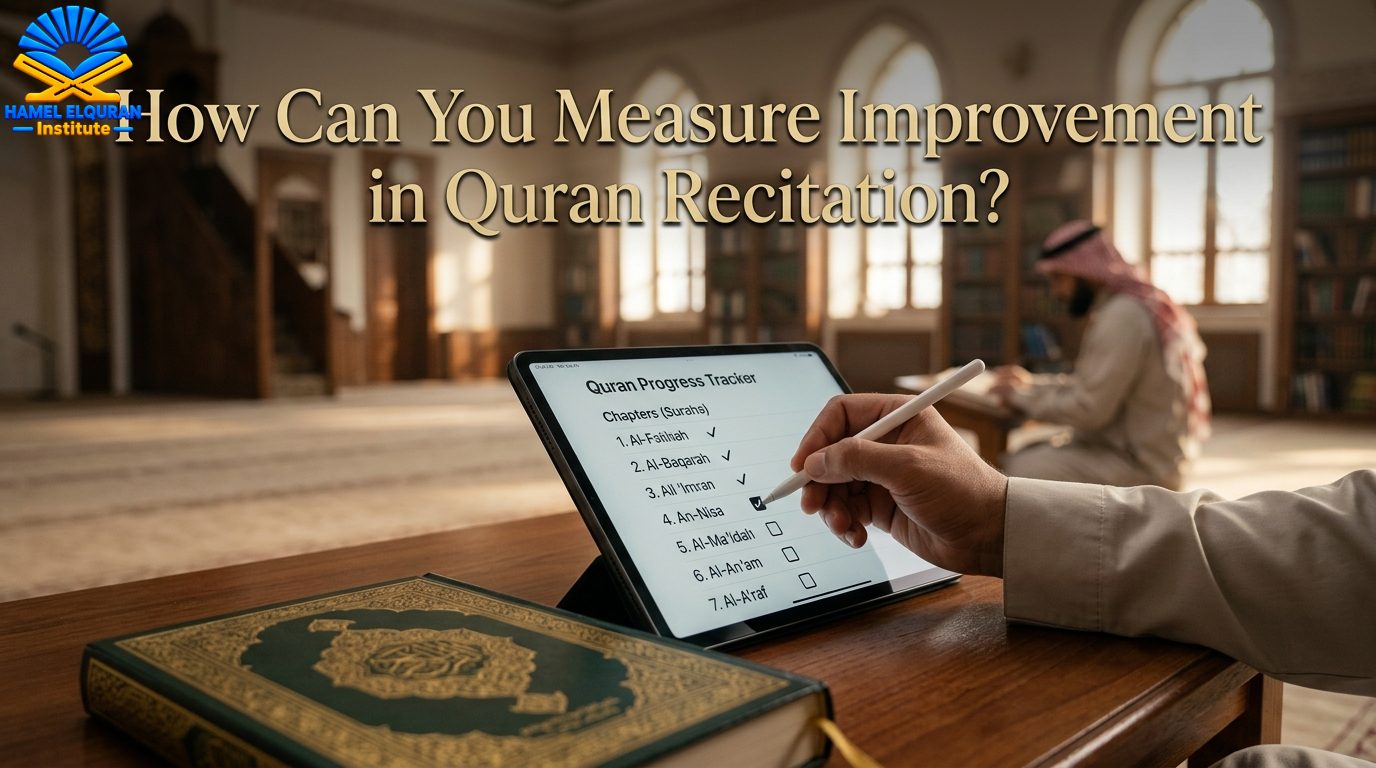
Progress does not depend only on how many pages you can read. Accuracy, consistency, and your ability to recognize and correct mistakes are also important indicators.
You can review your development by checking several areas:
- Letter pronunciation: Are you distinguishing between similar Arabic sounds more consistently?
- Reading accuracy: Are you making fewer repeated mistakes when reading familiar passages?
- Tajweed application: Can you recognize and apply the rules you have studied?
- Reading fluency: Can you read familiar passages more smoothly without rushing?
- Independent practice: Can you identify areas that need further review?
- Consistency: Are you maintaining a realistic routine for practising and revising?
Comparing your current reading with earlier practice can help you recognize changes that may otherwise be difficult to notice. You can also keep a list of recurring mistakes and review it periodically.
Progress will not always be linear. A new passage or a more difficult Tajweed rule may require extra effort, even when your overall reading has improved. Treat these challenges as useful information about what to practise next.
The aim is not simply to finish more material. It is to develop increasingly accurate recitation and maintain the habits needed for continued learning. Learners can deepen their understanding of Islamic teachings through Islamic Studies Online Classes that cover relevant topics in a structured learning environment.
Frequently Asked Questions About Quran Recitation Classes Online
Find answers to common questions about Quran recitation classes online, including learning requirements, Tajweed, practice frequency, and how to choose the right course for your goals.
1. What Are Quran Recitation Classes Online?
Quran recitation classes online are lessons delivered over the internet to help learners improve Quran reading, pronunciation, and Tajweed. Depending on the course, lessons may also cover Arabic reading foundations, fluency, and revision.
2. Can I Improve My Quran Recitation Without Knowing Tajweed?
You can begin improving your reading before learning all the Tajweed rules. However, studying Tajweed progressively helps you understand the principles of correct recitation and apply them more consistently. Beginners can start with foundational reading and pronunciation skills.
3. How Often Should I Practise Quran Recitation?
Your practice schedule should reflect your level, availability, and learning goals. Short, regular sessions can help reinforce lesson material, while reviewing earlier passages supports retention. Choose a realistic routine that you can maintain consistently.
4. How Do I Choose the Right Online Quran Recitation Course?
Start by identifying your main learning goal and current reading level. Then compare the course content, teaching approach, available lesson formats, and opportunities to review progress. Choose an option that addresses your needs and supports a manageable practice routine.
Conclusion
Quran recitation classes online can help learners build stronger reading skills, improve pronunciation, and understand how to apply Tajweed rules. The most suitable learning approach depends on your current level, the difficulties you want to address, and the time you can devote to regular practice.
Beginners should establish a foundation in Arabic reading before progressing to more advanced skills. Learners with previous experience can focus on pronunciation, fluency, and specific recitation rules that need further attention.
By choosing appropriate lessons, practising consistently, and reviewing recurring mistakes, you can make your learning more organized and purposeful. Hamel El-Quran Academy offers a place to explore online Quran learning options and identify a suitable next step for your recitation goals.