
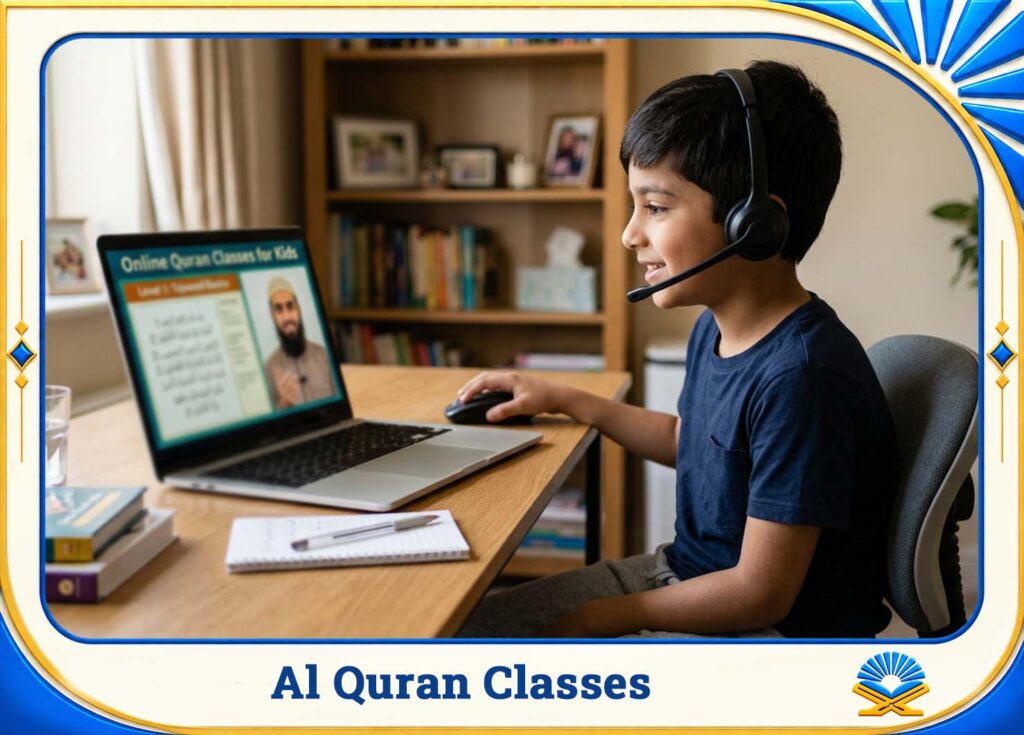
Al Qran classes can support different learning goals depending on a student’s current ability, previous experience, and desired outcome. A complete beginner may need to build basic Quran reading skills, while another student may already read comfortably but need focused Tajweed correction. A learner working toward Hifz may need a structured balance between new memorization and Muraja’ah.
This is why Quran learning does not follow one identical path for every student. At Hamel El-Quran Academy, the most useful starting point depends on what you can already do, what you need to improve, and how much time you can consistently dedicate to learning and practice.
Before choosing a program, ask yourself one practical question: What Quran skill needs the most attention right now? Your answer can help you decide whether to focus on reading, Tajweed, memorization, revision, or understanding.
This guide explains the main Quran learning paths, what happens during a lesson, how teachers assess students, the benefits of structured learning, and what to consider before choosing an online program.
What Do You Learn in Quran Classes?

Quran education involves more than memorizing passages. Depending on the student’s level and objective, lessons can develop several connected skills. A program may include:
- Learning Arabic letters and their correct sounds
- Building basic Quran reading skills
- Improving reading fluency
- Correcting pronunciation
- Learning and applying Tajweed rules
- Practicing accurate Quranic recitation
- Memorizing new portions
- Reviewing previously memorized passages
- Learning commonly used Quranic vocabulary
- Exploring translation or Tafsir at an appropriate level
These areas do not have to receive equal attention. A beginner may spend most of the early lessons developing reading fundamentals, while an experienced reader may benefit more from detailed recitation correction.
The value of a Quran program therefore depends less on the number of subjects it contains and more on whether the lessons address the student’s actual learning needs.
Start Your Quran Learning Journey Today
Are you ready to learn the Quran with confidence and consistency? Hamel El-Quran Academy offers online Quran learning opportunities designed to help students improve their Quran reading, recitation, Tajweed, and memorization from home. With structured lessons and personalized guidance, you can develop your skills step by step according to your learning goals.
Join Hamel El-Quran Academy today and take the next step toward building a stronger and more meaningful connection with the Quran.

How Do You Identify the Right Quran Learning Path?
Many students know they want to improve their Quran learning but are unsure where to begin. A simple self-assessment can help identify the difference between skills you already have and those that need more attention. Ask yourself:
- Can I recognize Arabic letters and pronounce them correctly?
- Can I read Quranic words without frequent hesitation?
- Do I understand and apply basic Tajweed rules?
- Do I notice recurring pronunciation or recitation mistakes?
- Am I trying to memorize new Surahs or Juz?
- Do I struggle to retain portions I memorized previously?
- Do I want to understand Quranic vocabulary and meanings?
Your answers can indicate an appropriate starting point. For example, a student who struggles to read connected Arabic words should strengthen reading fundamentals first. Someone who reads fluently but makes recurring pronunciation mistakes may benefit from focused Tajweed practice.
A learner who has already memorized substantial portions may need a stronger Muraja’ah routine rather than additional beginner reading lessons.
Identifying the actual learning gap makes each lesson more focused and reduces time spent practicing material that the student has already mastered.
What Should Complete Beginners Learn First?
A complete beginner needs a foundation that makes later Quran study easier. Starting with advanced recitation rules before developing basic reading skills can create unnecessary difficulty. Early lessons may introduce:
- Arabic letters and their sounds
- Different letter shapes and connections
- Vowels and basic reading patterns
- Correct pronunciation of Quranic words
- Reading short and familiar passages
- Building accuracy through guided practice
The goal is not simply to recognize letters individually. Students gradually need to connect letters, read complete words, and become more comfortable with Quranic text.
As reading becomes more reliable, the learner can progress toward greater fluency, Tajweed, and recitation practice. Early correction is also valuable because it can prevent inaccurate pronunciation patterns from becoming difficult habits.
For this reason, beginner al-Quran classes should progress according to the student’s actual reading ability rather than following an unnecessarily fast sequence.
When Should You Focus on Tajweed?
Tajweed becomes particularly important when a student can read Quranic text but wants to improve the accuracy of recitation. A learner does not necessarily need to wait until reading is perfect. Tajweed can develop alongside reading when the student has enough familiarity with Quranic words to understand and apply the relevant rules. Depending on the learner’s level, Tajweed study may cover:
- Articulation points of Arabic letters
- Characteristics of letters
- Noon Sakinah and Tanween
- Meem Sakinah
- Madd and elongation
- Ghunnah
- Qalqalah
- Appropriate stopping and starting
Learning the definitions of these rules is only one part of Tajweed. Students also need to hear examples, recite themselves, receive correction, and repeat difficult passages. This practical cycle of explanation, listening, recitation, correction, and repetition helps turn theoretical knowledge into an actual recitation skill.
How Does Quran Memorization Work?
Hifz requires a different learning structure because the goal is not simply to read a passage correctly once. The student needs to retain the material and recall it accurately later. A manageable memorization routine may involve:
- Choosing an amount that fits the student’s current level
- Listening carefully to the selected passage
- Reading it repeatedly from the Mushaf
- Reciting it without looking
- Correcting mistakes before adding more material
- Connecting new verses with the preceding passage
- Reviewing previous memorization consistently
The amount memorized during a single lesson is not the only measure of progress. Retention matters just as much. Memorizing a large portion quickly without reviewing it can create weaknesses later. A smaller target combined with regular revision may provide more stable long-term retention.
A practical Hifz plan therefore treats memorization as an ongoing process rather than a race to complete a particular number of pages.
Why Is Muraja’ah Important for Memorization?
New memorization and previous memorization require different forms of attention. When students continue adding new passages without reviewing earlier material, those sections can gradually become less secure. Muraja’ah provides a system for maintaining memorized portions. A revision routine can include:
- Reviewing recently memorized passages
- Revisiting older sections regularly
- Reciting selected portions without looking
- Recording recurring mistakes
- Giving additional attention to weak passages
- Adjusting revision time when retention decreases
The appropriate amount of Muraja’ah varies according to the student’s memorization level, previous consistency, and available practice time. For students working toward Hifz, a learning plan should therefore account for both new material and existing memorization. Revision should be treated as part of memorization itself rather than as an optional activity.
Can Quran Lessons Include Understanding and Meaning?
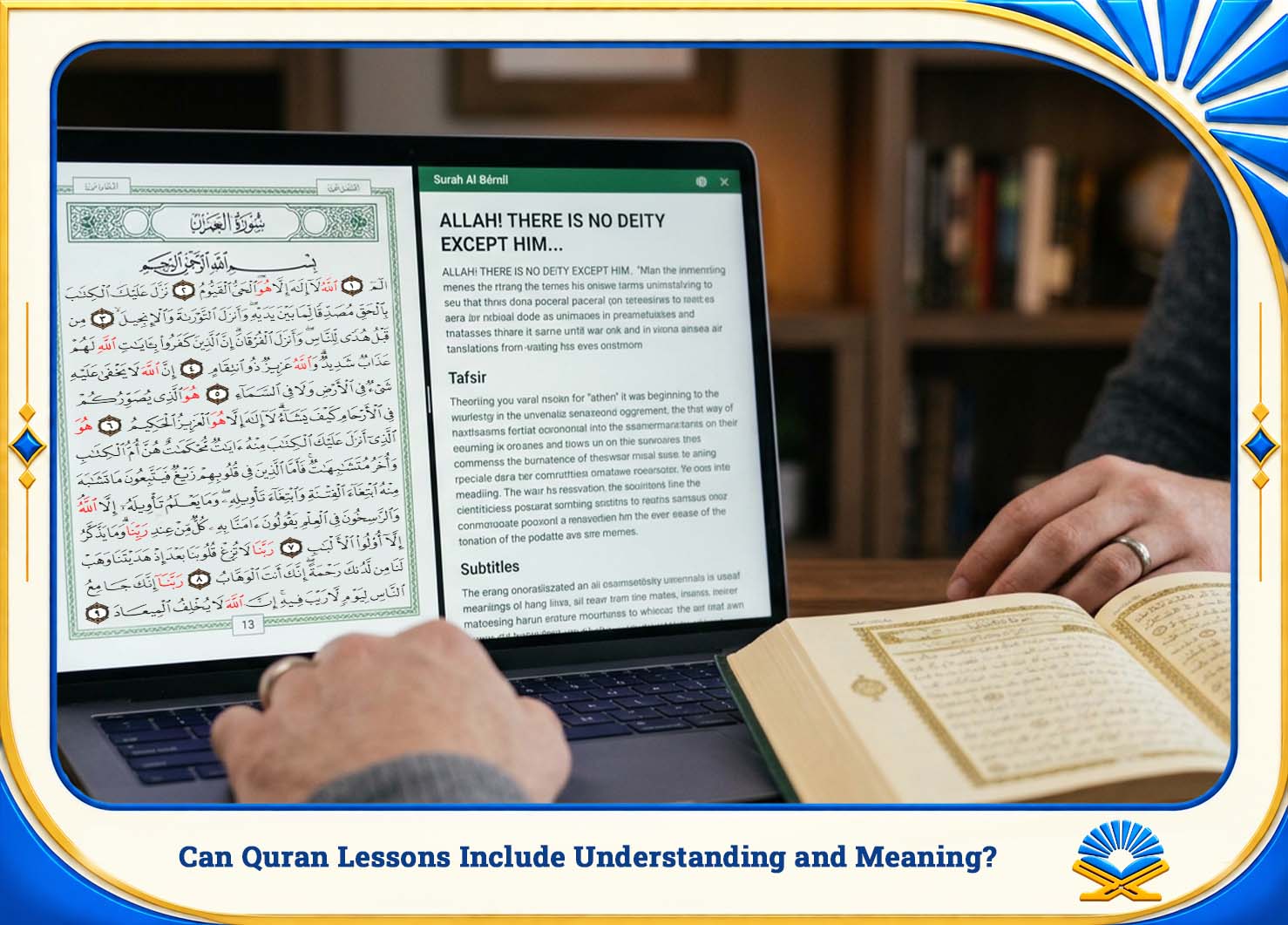
Yes. Quran study can include understanding alongside reading, recitation, and memorization when that matches the learner’s objective. Some students want to understand commonly repeated Quranic words. Others may be interested in translation, themes, or Tafsir after developing a stronger foundation.
The depth of study should match the student’s background. A beginner may benefit from learning the meaning of familiar words without taking on an extensive interpretation course. A more advanced learner may be ready to explore broader explanations and linguistic details.
Understanding can also support other learning goals. Knowing the meaning of selected verses may help students engage more thoughtfully with what they are reciting, while learners focused on Quranic studies may want more lesson time dedicated specifically to meaning and interpretation. The goal is to add understanding at a level that supports the learner’s main objective.
What Happens During a Quran Lesson?
A useful Quran lesson should have a clear purpose. Instead of spending every session simply reading from beginning to end, the teacher can use the student’s performance to determine what needs attention. Depending on the learning goal, a lesson may include:
- Reviewing previous work
- Introducing a new passage or skill
- Listening to the student’s recitation
- Identifying specific errors
- Explaining the correction
- Practicing the corrected pronunciation or rule
- Assigning material for practice or revision
A beginner may spend most of the lesson developing reading skills. A Tajweed student may spend more time correcting specific recitation errors. Regular practice can make online quran learning for kids more consistent and engaging.
A Hifz student may divide the lesson between new memorization and Muraja’ah. This makes the lesson responsive rather than fixed. The student’s performance should influence what is practiced next.
How Is a Student’s Quran Level Assessed?
Before creating a learning plan, a teacher needs to understand what the student can already do. An initial assessment may involve listening to the learner read selected passages, observing pronunciation, checking basic Tajweed application, and discussing previous Quran study. The teacher may also ask about the student’s goals and available practice time.
Two students with similar reading abilities may still need different learning plans. One may want to improve recitation, while another may be preparing for Hifz. A useful assessment should establish three things:
- Current ability: What can the student already perform confidently?
- Learning gaps: Which skills or recurring mistakes need attention?
- Immediate priority: What should the student work on first?
This gives the teacher a practical basis for planning Quran lessons instead of placing every learner into the same sequence. Parents can introduce children to Quran study through quran classes for kids designed around their learning needs.
What Are the Benefits of Structured Quran Learning?
A structured approach can make Quran study more purposeful because each lesson has a defined objective and connects to the student’s previous work. Some practical benefits include:
- Consistent progress: Students know what they are working toward rather than studying unrelated material.
- Early correction: Teachers can identify pronunciation and recitation problems before they become established habits.
- Focused practice: Lesson time can be directed toward the skills that need the most attention.
- Stronger retention: Memorization plans can include regular Muraja’ah instead of focusing only on new material.
- Clearer progress tracking: Students can recognize changes in reading accuracy, fluency, recitation, or memorization.
- Personalized learning: The pace and lesson focus can change as the student’s ability develops.
Structured learning does not mean every student follows the same curriculum. In practice, structure works best when it provides a clear framework while allowing the learning plan to adapt to the student’s needs.
What Should You Check Before Choosing an Online Quran Program?
Online Quran learning can be convenient, but convenience alone does not determine whether a program is suitable. The important question is whether the teaching structure supports your particular goal. Before enrolling, consider:
- Is the program suitable for your current reading level?
- Can beginners receive foundational instruction?
- Can advanced students receive specialized guidance?
- Does the teacher listen carefully to the student’s recitation?
- Are mistakes corrected during the lesson?
- Is there enough time for actual practice?
- How are memorization and revision organized?
- Can the schedule fit your routine?
- How is progress communicated?
- Can the learning plan change as your skills develop?
A course does not become more useful simply because it contains more subjects. What matters is whether the program connects your current ability with a realistic next step. Families can support children’s Quran education with online quran classes for children from home.
How Can Hamel El-Quran Academy Support Your Learning Goal?
The decision to join a Quran academy becomes clearer after identifying what you actually want to improve. A beginner may need structured reading instruction. A student who already reads well may need Tajweed and direct recitation correction. Someone pursuing Hifz may need a plan that balances new memorization with Muraja’ah. Another learner may want to combine Quran study with vocabulary or understanding.
A structured online learning option can help connect the student’s starting point with a practical learning path. If online study matches your needs, you can explore online quran classes and discuss which type of instruction fits your current level and objective.
The important step is to choose a learning path based on your actual needs rather than selecting a course simply because its title sounds suitable.
How Can You Measure Quran Learning Progress?
Progress should be connected to the student’s actual goal. For a reading student, improvement may appear as fewer pauses, better pronunciation, and greater confidence. A Tajweed student may notice fewer recurring errors and better application of rules during recitation.
For a Hifz student, progress includes both new memorization and the ability to retain older portions. Other useful signs include:
- More accurate pronunciation
- Smoother Quran reading
- Fewer recurring recitation mistakes
- Greater confidence when reading aloud
- Stronger retention of memorized passages
- More independent revision
- Better understanding of commonly used Quranic vocabulary
Progress does not always happen at the same speed. Some skills improve quickly, while others require repeated practice. What matters is having clear learning targets so that the student and teacher can recognize what has improved and determine what should be practiced next.
Common Mistakes When Choosing Quran Lessons
Choosing a Quran program can become difficult when decisions are based on general promises rather than the learner’s actual needs. Avoid these common mistakes:
- Choosing a program only because it is long: A longer course is not automatically more suitable. The content should match the student’s level and learning objective.
- Starting with material that is too advanced: Students who have not developed basic reading skills may struggle when lessons assume knowledge they do not yet have.
- Focusing on new memorization while neglecting revision: Hifz requires both new learning and regular Muraja’ah. Older portions need consistent review to remain secure.
- Enrolling without understanding the assessment process: Knowing how the teacher evaluates your level can help you determine whether the program is adapted to your current abilities.
- Expecting lessons to replace personal practice: A teacher provides instruction and correction, but students still need regular practice between lessons. Consistency is especially important for reading, Tajweed, and memorization.
Avoiding these mistakes makes it easier to choose Quran lessons based on actual learning needs rather than general marketing claims.
Which Quran Learning Path Fits Your Current Goal?
Your current ability and learning objective can help you identify the most relevant starting point. Use the following guide to match your current situation with the Quran learning focus that may suit you best.
| Current situation | Suitable learning focus |
|---|---|
| You are not confident with Arabic letters | Basic Quran reading |
| You can read but make frequent pronunciation errors | Reading correction |
| You read comfortably but need better recitation | Tajweed |
| You want to memorize new portions | Hifz |
| You have memorized portions but struggle to retain them | Muraja’ah |
| You want to understand what you recite | Vocabulary, translation, or Tafsir |
| You have several goals | A structured combination based on your level |
This table is not a fixed curriculum. Some students may need to work on two areas at the same time. For example, a learner can improve Tajweed while beginning a structured memorization plan.
The purpose is to identify the skill that deserves the greatest attention at the current stage. As your reading, recitation, memorization, or understanding improves, your learning focus can also change.
Who Can Benefit From Quran Classes?
- Children may need gradual instruction, clear explanations, and regular encouragement while developing reading or memorization skills.
- Adult beginners can start from the fundamentals without assuming previous Quran reading experience. A structured progression can help them build confidence step by step.
- Fluent readers may benefit from focused Tajweed instruction, pronunciation correction, and detailed recitation practice.
- Hifz students need a learning structure that protects previous memorization while introducing new portions.
- Students interested in understanding may combine reading and recitation with vocabulary, translation, or Tafsir according to their level.
Age can influence the teaching approach, but the learning plan should also consider ability, goals, available time, and the pace the student can realistically maintain.
How Can You Start Without Choosing the Wrong Program?
You do not need to know every detail of your future Quran study before speaking with a teacher. Begin with three practical pieces of information.
- 1. Know your current level: Are you a complete beginner, a basic reader, a fluent reader, or already memorizing?
- 2. Define your immediate goal: Do you want to improve reading, Tajweed, Hifz, Muraja’ah, or understanding?
- 3. Decide how much time you can maintain: Consider both lesson frequency and the practice you can realistically complete between sessions.
If you are unsure about your level, an assessment can help identify an appropriate starting point. The objective is not to enter the most advanced course available. It is to begin with the skill that will make the learning process more effective.
How Do Online Quran Classes Become More Effective?
The effectiveness of online learning depends partly on how the student uses lesson time and practices between sessions. A useful routine can be simple:
- Review the previous lesson before the next session.
- Practice difficult pronunciation points repeatedly.
- Read assigned Quranic passages aloud.
- Review memorized portions instead of focusing only on new material.
- Write down recurring mistakes.
- Ask the teacher about anything that remains unclear.
- Track the skills that are improving.
The purpose is not to create a complicated study schedule. It is to make each lesson part of a continuous learning process. When students know what they practiced previously and what they need to improve next, online lessons become easier to follow and progress becomes easier to recognize.
How to Enroll in Al Quran Classes?
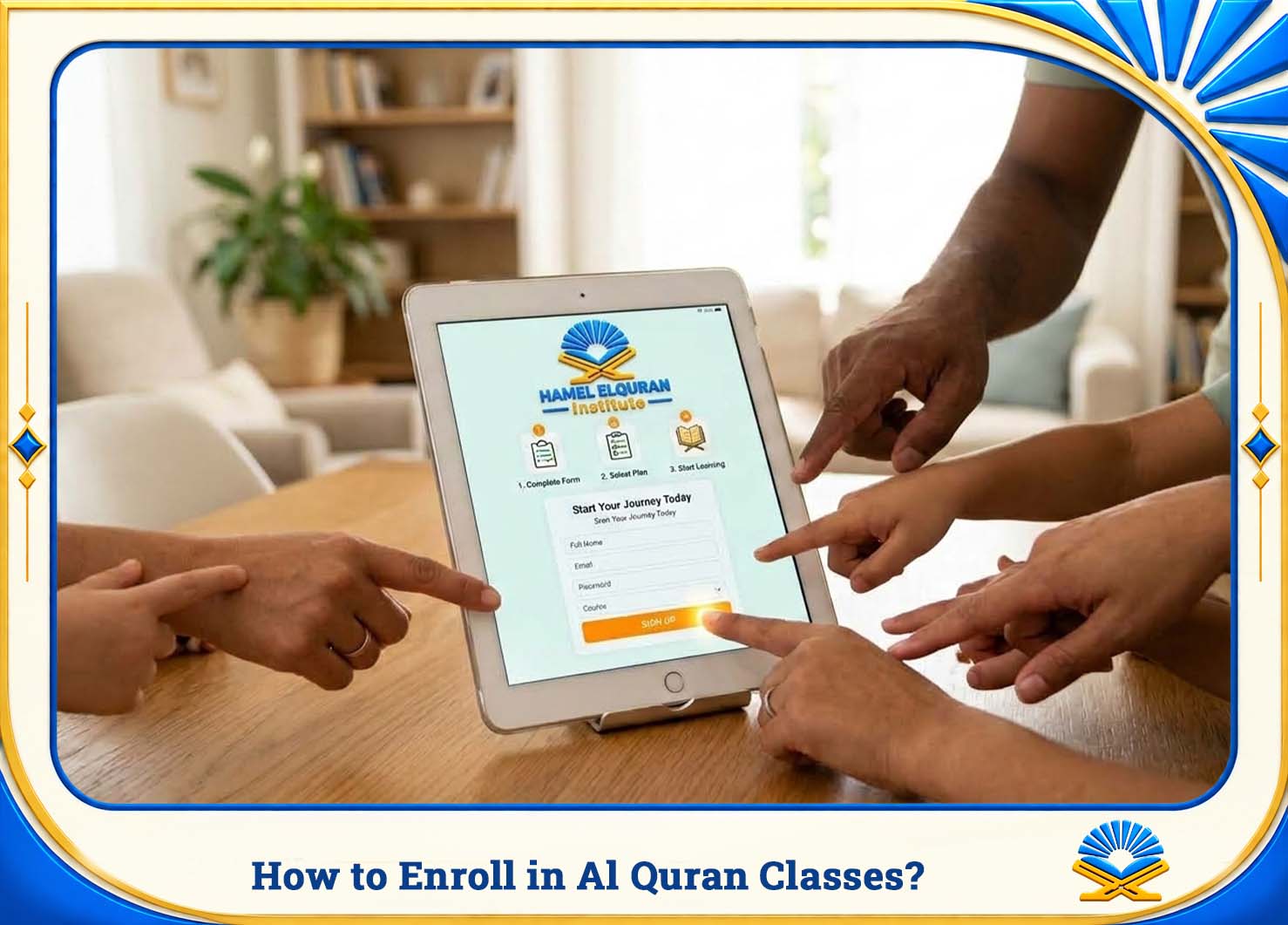
Once you have identified your level and learning goal, the enrollment process becomes more straightforward. Start by deciding what you want to improve. You may need basic Quran reading, Tajweed instruction, memorization, or stronger revision. Having a specific objective makes it easier to discuss the appropriate learning path with the academy.
Next, ask about the class structure, teaching approach, schedule, and assessment process. If the academy evaluates students before assigning a program, use that opportunity to explain your previous experience and learning goals.
You can then select a schedule that fits your routine and begin with a defined learning objective. As your ability changes, the focus of your lessons may also need to change.
Enrollment should therefore be more than simply registering for a class. It can be the beginning of a learning process built around your current ability and next learning target.
Frequently Asked Questions About Al Quran Classes
Here are answers to four common questions learners may have before starting Quran lessons.
Are al quran classes suitable for complete beginners?
Yes. Complete beginners can start with Arabic letters, pronunciation, and basic Quran reading. The learning plan should begin at the student’s actual level rather than assuming previous experience.
Can I learn Tajweed without memorizing the Quran?
Yes. Tajweed focuses on improving Quranic recitation, so students can study its rules and practice applying them without committing to a complete Hifz program.
How often should I attend Quran lessons?
The appropriate schedule depends on your goal, available time, and ability to practice between lessons. A manageable schedule that you can maintain consistently is generally more practical than one that is difficult to follow.
How do I know whether an online Quran program suits me?
Check whether the program matches your current level, supports your specific goal, provides meaningful recitation feedback, offers a practical schedule, and gives you a clear way to monitor progress.
In conclusion, the right Al-Quran classes should begin with the learner’s actual needs rather than a generic course structure. Reading, Tajweed, Hifz, Muraja’ah, and Quranic understanding each require different forms of practice, and some students may need to combine more than one of them.
Start by identifying your current ability, decide what you want to improve first, and consider how much time you can realistically dedicate to lessons and practice. From there, an assessment and a clear learning plan can establish an appropriate starting point.
Whether you are learning to read the Quran for the first time, improving your recitation, memorizing new portions, or strengthening previous memorization, a structured approach can make each lesson more purposeful. The goal is not simply to complete classes, but to develop lasting Quran learning skills that continue to improve through consistent practice.