
Quran Tajweed classes are designed for students who can already read the Quran but want to improve their pronunciation, accuracy, and overall recitation. You may know how to read Quranic words yet still struggle with certain Arabic letters, forget a Tajweed rule while reading, or repeat the same pronunciation mistake without noticing it. These issues are common when you practice alone because it can be difficult to hear your own mistakes.
Tajweed study gives you a structured way to understand the rules and apply them during actual Quran recitation. Instead of memorizing definitions without practice, you work with Quranic words and verses, receive correction, and repeat difficult sounds or passages until the correct reading becomes more familiar.
At Hamel El-Quran Academy, online Tajweed lessons are adapted to the learner’s current reading level and specific areas of difficulty. Students can practice directly with a teacher, improve recurring mistakes, and build greater consistency in their recitation through focused guidance.
What Are Quran Tajweed Classes
Quran Tajweed classes teach you how to pronounce Quranic letters correctly and apply the rules that govern proper recitation.
You may already know how to read the words but still hesitate over certain sounds or wonder whether you are applying a rule correctly. Some mistakes are particularly difficult to notice when you have been reading in the same way for years.
Guided practice helps address these issues. Rather than stopping at an explanation of a Tajweed rule, the lesson gives you a chance to read, hear the correction, and try again.
A lesson may involve:
- Reviewing mistakes from an earlier lesson.
- Introducing a pronunciation point or Tajweed rule.
- Listening to the teacher demonstrate the correct reading.
- Reciting words or verses yourself.
- Correcting mistakes as they occur.
- Repeating sounds or passages that need more work.
- Using the same rule in a different Quranic passage.
Over time, this helps turn Tajweed knowledge into something you can actually use while reading.
Tajweed Rules We Teach
There is no single set of rules that every student needs to study at the same pace. Your starting point depends on how comfortably you already read and which parts of your recitation need attention.
Makharij Al-Huroof
Makharij Al-Huroof are the articulation points of the Arabic letters. Getting these sounds right is one of the foundations of clear Quran recitation.
For a learner who did not grow up speaking Arabic, some letters can sound very similar even though they require different movements of the tongue, throat, lips, or mouth. Knowing the name of a letter does not necessarily mean producing its sound correctly.
During practice, the teacher can demonstrate the sound and listen carefully to how you produce it. If the pronunciation is slightly off, you can work on that particular movement instead of treating the entire reading as a problem.
The aim is simple: to make accurate pronunciation more natural when the letter appears inside a Quranic word.
Noon and Meem Rules
Noon Sakinah, Tanween, and Meem Sakinah have different Tajweed rulings depending on the letters that follow them.
Students may work on:
- Izhar
- Idgham
- Iqlab
- Ikhfa
- Rules of Meem Sakinah
At first, these names can feel like a lot to remember. The real challenge, however, comes when you meet the rule while reading and need to apply it without breaking the flow of recitation.
That is why Quranic examples are useful. Seeing the rule in an actual word or verse makes it easier to connect the explanation with what you hear and read.
Madd Rules
Madd concerns the elongation of sounds during Quran recitation. A student may understand the basic idea but still shorten a sound in one place and extend it too much in another. Without someone listening, these differences can easily become part of a regular reading habit.
Lessons can therefore focus on recognizing where Madd occurs and practicing the appropriate length until the reading becomes more consistent.
Stopping and Starting Rules
Good recitation is not only about how individual words are pronounced. Knowing when to stop and how to resume also matters.
You may read every word correctly and still be unsure about where a pause should occur. Practicing Waqf and Ibtida with actual Quranic passages helps make these decisions easier to recognize during reading.
Instead of studying stopping and starting as an isolated topic, students can apply it directly while reciting.
Tajweed Classes for Beginners and Advanced Students
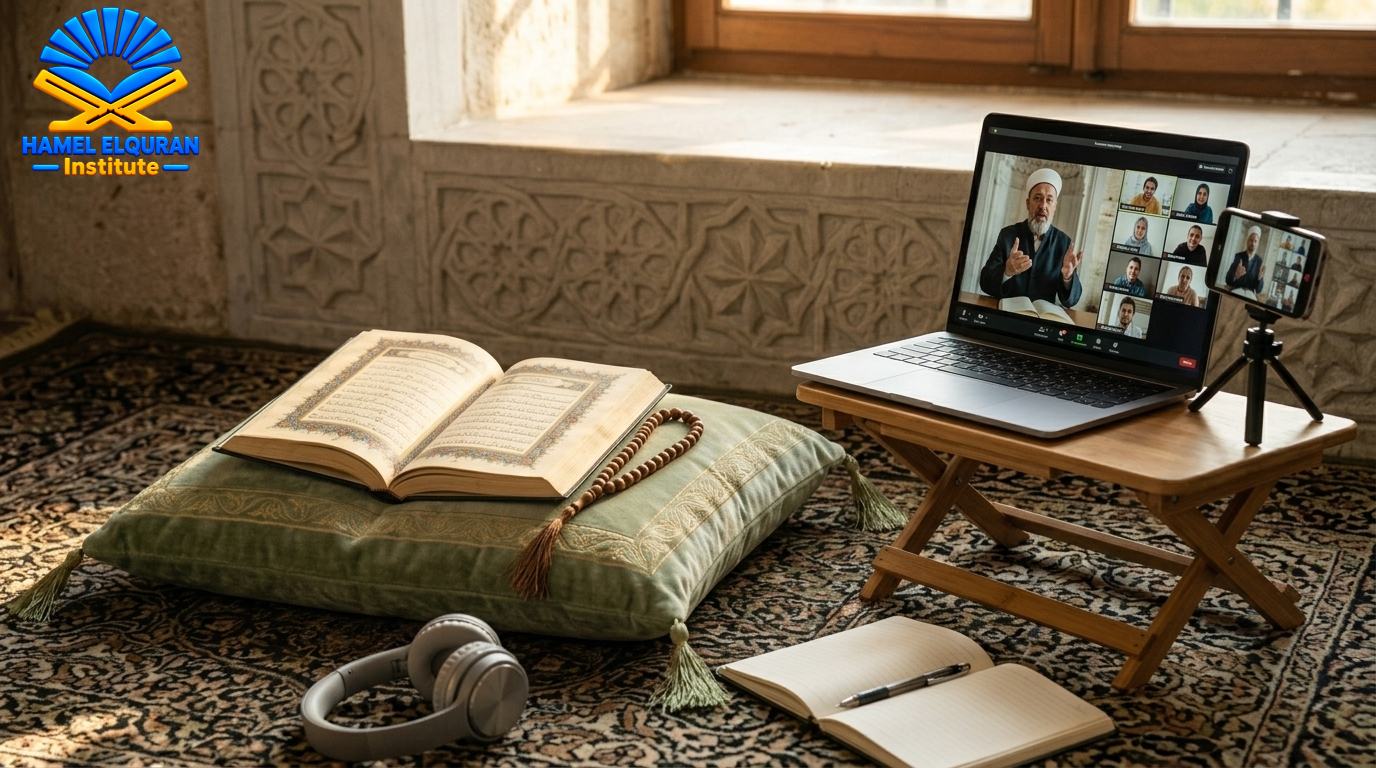
Students come to Tajweed with very different backgrounds. Some are still building confidence in Quran reading, while others have been reading for years and are mainly looking for correction and refinement.
For Beginners
A beginner does not necessarily need to learn Quran Online with Tajweed and every Tajweed rule immediately. The first step is to understand where the student currently stands. This may include looking at:
- Recognition and pronunciation of Arabic letters.
- Ability to read Quranic words.
- Common pronunciation difficulties.
- Familiarity with basic Tajweed concepts.
- Confidence when reading short passages.
From there, lessons can progress gradually. A student who needs more work on letter pronunciation should not be rushed into detailed rules simply because they appear later in a textbook.
For Students Who Already Read the Quran
This is where many Tajweed learners find themselves. You can read the Quran, but you know your recitation is not quite where you want it to be.
Maybe you:
- Make the same pronunciation mistake repeatedly.
- Forget a rule when reading quickly.
- Find some Arabic letters difficult.
- Apply Madd inconsistently.
- Feel unsure about where to stop.
- Want your overall recitation to sound more controlled.
In this situation, starting from the very beginning may not be the best use of your time. An assessment of your reading can show which areas deserve attention first.
For Advanced Students
More experienced readers often need a different kind of practice.
Instead of spending most of the lesson learning basic definitions, they may benefit from working through longer passages, maintaining accurate pronunciation while reading continuously, and identifying subtle mistakes that are easy to miss when practicing alone.
At this stage, consistency becomes just as important as knowing the rule itself.
Practice Quran Recitation With a Teacher
There is a difference between knowing a Tajweed rule and remembering to use it while reading.
Imagine that you have just learned a rule and can explain it perfectly. A few minutes later, you are reading a new verse and your attention shifts to the next word. The rule may suddenly disappear from your mind.
That is why recitation practice matters.
A useful practice cycle is:
Listen → Recite → Identify the mistake → Correct it → Repeat → Apply it in a new passage
The process is straightforward, but repeated practice can make a noticeable difference. Instead of trying to improve everything at once, you work on one issue, use it in different words or verses, and gradually make the correction part of your normal reading.
At Hamel El-Quran Academy, students can recite directly to a teacher during online Tajweed lessons and work on the areas that appear during their reading.
Why Choose Hamel El-Quran Academy for Quran Tajweed Classes?
Hamel El-Quran Academy offers online Tajweed learning for students who want to work on their Quran recitation with direct teacher guidance.
The approach can be suitable for learners looking for:
- One-to-one online Quran lessons.
- Tajweed instruction suited to their current level.
- Direct correction during recitation.
- Support for beginners and experienced learners.
- Quran lessons for children and adults.
- A clear starting point based on individual needs.
- A free trial Quran lesson before continuing with regular study.
The emphasis is on using Tajweed while reading, not simply collecting rules to memorize. Students can work through the areas where they need more practice and gradually bring those corrections into their regular recitation.
Start Improving Your Quran Recitation
If you already read the Quran but want to improve your pronunciation and apply Tajweed rules more accurately, Hamel El-Quran Academy can help you take the next step. Start with a lesson suited to your current reading level, practice directly with a teacher, and focus on the areas that need improvement.
Contact Hamel El-Quran Academy to begin your Quran Tajweed classes and arrange a free trial Quran lesson.

One-to-One Quran Tajweed Classes
One-to-one lessons can be especially useful when your needs are specific. If you struggle with one or two particular letters, for example, you may need more time to practice those sounds than another student. An individual lesson makes it possible to slow down, repeat an example, or move to a different Quranic passage when necessary.
It can also suit adults who have developed long-standing pronunciation habits and children who need more individual attention.
At Hamel El-Quran Academy, students can take one-to-one online Quran lessons, giving the teacher the opportunity to work directly with the individual learner.
Quran Tajweed Classes for Children
Children can study Tajweed online when the lesson is adapted to their age and reading ability.
A young learner may need shorter explanations and more repetition than an adult. If the child is still learning to read Arabic, it may also make sense to strengthen basic reading skills before introducing more detailed Tajweed terminology.
Parents can ask how the teacher handles mistakes, how much time the child spends actually reciting, and whether the material is adjusted when a particular sound or rule proves difficult.
For children, understanding the rule matters, but so does keeping the lesson clear enough for them to use it confidently.
What an Online Tajweed Lesson Looks Like
An online Tajweed lesson should not feel like a lecture where the student spends most of the time listening.
A typical session may include:
- A quick review of the previous lesson.
- A new pronunciation point or Tajweed rule.
- An example from the teacher.
- Student recitation.
- Corrections and repeated practice.
- Application of the rule in Quranic words or verses.
- A short review of what to practice next.
Not every lesson will look exactly the same. Someone working on Makharij may spend much of the session repeating individual sounds. A more experienced reader may spend most of the time reading longer passages and working on consistency.
The lesson should change according to what the student actually needs.
Choosing the Right Quran Tajweed Classes
The course title alone cannot tell you whether a Tajweed program is suitable. Pay attention to what actually happens during the lessons.
Before committing to regular classes, you may want to ask:
- Will the teacher listen to my recitation directly?
- How are pronunciation mistakes explained and corrected?
- Can the lessons be adjusted to my current level?
- Are the classes individual or group-based?
- How are lessons adapted for children?
- What happens when I struggle with a particular rule?
- How is progress reviewed?
- Can I try a lesson before continuing?
The answers can tell you more about the teaching approach than a long list of course topics.
Starting Quran Tajweed Classes
Starting does not have to be complicated. The most useful first step is to understand what you actually need to improve.
1. Identify Your Goal
Think about the main reason you want to study Tajweed. You may want clearer pronunciation, better understanding of the rules, more accurate reading, or preparation for a more advanced stage of Quran study.
2. Assess Your Current Recitation
Reading a short passage for a teacher can reveal problems that are difficult to notice when you practice alone.
3. Choose the Appropriate Level
Your starting level should reflect your actual reading ability. Someone who has been reading the Quran for years may still need help with specific pronunciation issues, while another student may need to strengthen the basics first.
4. Set a Consistent Schedule
Choose lesson times that fit realistically into your routine. A manageable schedule is easier to maintain than one that becomes difficult after a few weeks.
5. Practice the Areas That Need Attention
Once your main difficulties are clear, practice can become more focused. Instead of trying to revise every Tajweed rule, spend more time on the sounds, rules, and passages that affect your recitation.
At Hamel El-Quran Academy, students can discuss their learning needs, identify a suitable starting point, and experience a free trial Quran lesson before continuing with regular classes.
Measuring Your Tajweed Progress
You do not need to rely only on how many Tajweed terms you can remember. Your actual reading is a better indicator.
You may notice progress when:
- The same pronunciation mistakes happen less often.
- Familiar rules become easier to recognize.
- Difficult Arabic letters become more natural to pronounce.
- Madd is more consistent.
- You make better choices when stopping and starting.
- Previously corrected mistakes require fewer reminders.
- You can apply familiar rules while reading a new passage.
Practice between lessons still matters. A correction becomes useful when you can carry it from the lesson into your regular Quran reading.
Common Mistakes When Choosing Quran Tajweed Classes

A Tajweed program may look suitable on paper but still fail to address what you personally need. Before choosing one, consider the actual learning experience.
Choosing a Course Without Knowing Your Level
A course that moves too quickly can leave a beginner confused. On the other hand, an experienced reader may become frustrated if every lesson stays at a very basic level.
Focusing Only on Tajweed Theory
Knowing definitions is helpful, but it does not replace recitation. You need opportunities to read, make mistakes, receive corrections, and try again.
Not Receiving Individual Feedback
If nobody regularly listens to your recitation, some mistakes can remain unnoticed for a long time.
Choosing Convenience Over Teaching Quality
A convenient schedule is useful, but it should not be the only consideration. The teacher still needs to explain clearly, listen carefully, and know how to guide your recitation.
Frequently Asked Questions About Quran Tajweed Classes
This section answers common questions about Quran Tajweed classes, including who can benefit from them, how lessons work, and how students can improve their recitation.
Who Can Benefit From Quran Tajweed Classes?
Quran Tajweed classes can benefit beginners, regular Quran readers, and advanced students who want to improve pronunciation, correct recurring mistakes, or apply Tajweed rules more accurately.
How Long Does It Take to Improve Quran Recitation With Tajweed?
The time varies according to your reading level, the areas that need correction, and how consistently you practice. Regular lessons and practice between sessions can help you make steady progress.
Can I Learn Quran Tajweed Online From Home?
Yes. Online Quran Tajweed classes allow you to recite directly to a teacher from home, receive pronunciation corrections, and practice Tajweed rules using Quranic words and verses.
Do I Need to Know Arabic Before Studying Tajweed?
You do not need to speak Arabic fluently to study Tajweed. However, you need enough Quran reading ability to work with Arabic letters, words, and verses. The appropriate starting level depends on your current reading skills.
Conclusion
Quran Tajweed classes can help you improve pronunciation, apply Tajweed rules correctly, and develop greater consistency in Quran recitation. The most effective learning approach focuses on your current reading level and gives you regular opportunities to recite, receive corrections, and practice difficult areas.
With consistent practice and direct teacher feedback, you can gradually correct recurring mistakes and become more confident in your recitation. Hamel El-Quran Academy offers online Quran Tajweed classes designed around individual learning needs, giving students a structured way to continue improving their Quran reading.