

An online quran course can provide a structured way to learn Quran reading, improve recitation, study Tajweed, memorize Quranic portions, or develop a deeper understanding of the Quran.
Hamel El-Quran Academy offers an online learning approach that can support learners with different Quranic learning goals. However, online courses can differ significantly in their curriculum, levels, lesson structure, and progression system.
A suitable course should do more than provide regular lessons. It should help learners understand what they are expected to learn, determine the appropriate starting level, practice their skills, and progress gradually as they improve.
Understanding the curriculum and course levels can therefore make it easier to choose a program that matches your current ability and learning goals.
What Does an Online Quran Course Include?
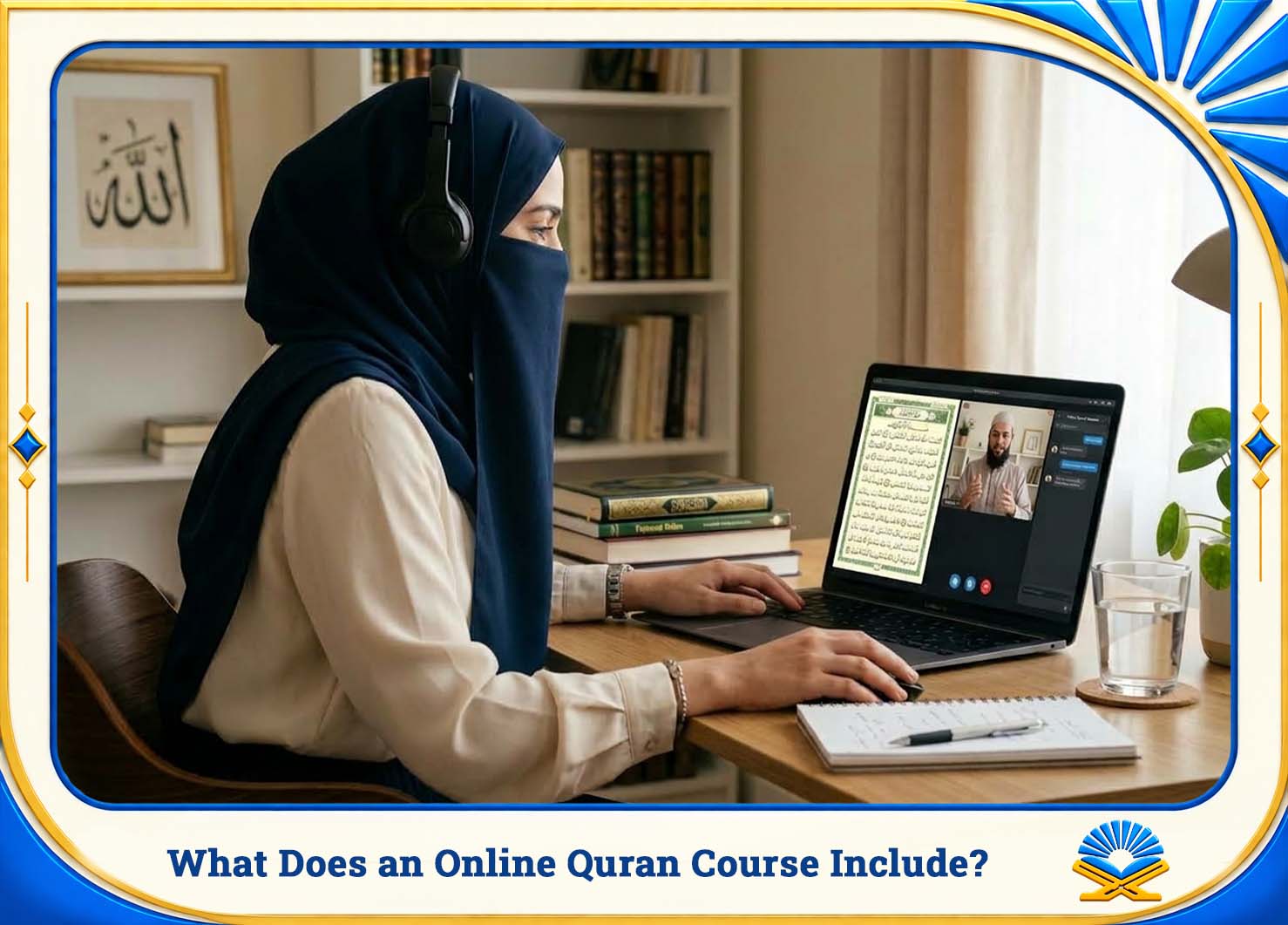
An online Quran course may cover different areas depending on the learner’s level and objectives. A beginner may need to learn Arabic letters and correct pronunciation, while an experienced reader may need more focused Tajweed practice or Quran memorization. A structured course commonly includes some combination of:
- Quran reading and letter recognition
- Arabic pronunciation and articulation
- Basic and advanced Tajweed
- Quran recitation practice
- Quran memorization
- Memorization revision
- Correction of common reading mistakes
- Gradual progress through different learning levels
- Regular feedback from the teacher
The exact curriculum should depend on the learner rather than assuming that every student should follow the same path.
For example, a child who is still learning Arabic letters should not be placed in the same starting level as an adult who already reads the Quran fluently. Likewise, a student whose main goal is Hifz may need a different lesson structure from someone who primarily wants to improve Tajweed.
Start Your Quran Learning Journey Today
Are you ready to learn the Quran with confidence and consistency? Hamel El-Quran Academy offers online Quran learning opportunities designed to help students improve their Quran reading, recitation, Tajweed, and memorization from home. With structured lessons and personalized guidance, you can develop your skills step by step according to your learning goals.
Join Hamel El-Quran Academy today and take the next step toward building a stronger and more meaningful connection with the Quran.

Online Quran Course Levels Explained
A clear level system helps learners understand where they should begin and what skills they can work toward next. The names of levels may differ between programs, but a structured curriculum can generally progress from foundational reading skills to more advanced Quran study.
Level 1: Quran Reading Foundations
This level is suitable for learners who cannot yet read the Quran confidently. The curriculum may focus on:
- Recognizing Arabic letters
- Connecting letters correctly
- Understanding basic vowel signs
- Pronouncing letters accurately
- Reading simple Arabic combinations
- Developing confidence with Quranic words
The goal is to establish the reading skills needed before moving into more detailed recitation and Tajweed work.
Level 2: Quran Reading and Basic Tajweed
Once learners can read basic Quranic words, they can begin working on reading accuracy and introductory Tajweed. Lessons may introduce:
- Correct pronunciation of Quranic letters
- Basic articulation points
- Common Tajweed rules
- Short and long vowel sounds
- Basic elongation
- Common reading mistakes
- Guided recitation practice
At this stage, learners should gradually move from simply recognizing words to reading them with greater accuracy.
Level 3: Accurate Quran Recitation
This level focuses more heavily on applying Tajweed while reading the Quran. Students may work on:
- Applying Tajweed rules during recitation
- Improving pronunciation
- Correcting recurring mistakes
- Practicing articulation points
- Improving consistency
- Reading longer passages with greater confidence
The teacher’s role becomes particularly important because learners need practical correction rather than only theoretical explanations.
Level 4: Quran Memorization and Revision
Learners who want to memorize the Quran may follow a curriculum centered on Hifz and regular revision. A structured memorization plan can include:
- Selecting an appropriate amount to memorize
- Repeating new verses
- Connecting verses
- Reviewing previously memorized portions
- Correcting recitation during memorization
- Monitoring retention over time
Memorization should not focus only on adding new verses. Regular revision is necessary to maintain previously learned portions.
Level 5: Advanced Quran Studies
More advanced learners may need a curriculum that goes beyond basic reading and Tajweed. Depending on the program, advanced study may include:
- More detailed Tajweed application
- Advanced recitation practice
- Continued Quran memorization
- Structured revision
- Deeper study of Quranic reading
- Additional Quran-related subjects according to the learner’s goals
The appropriate content at this stage depends heavily on the learner’s existing knowledge and the objectives of the course. Not every learner needs an advanced level, especially if their main goal is accurate Quran reading or basic Tajweed.
How Do You Progress Through an Online Quran Course?
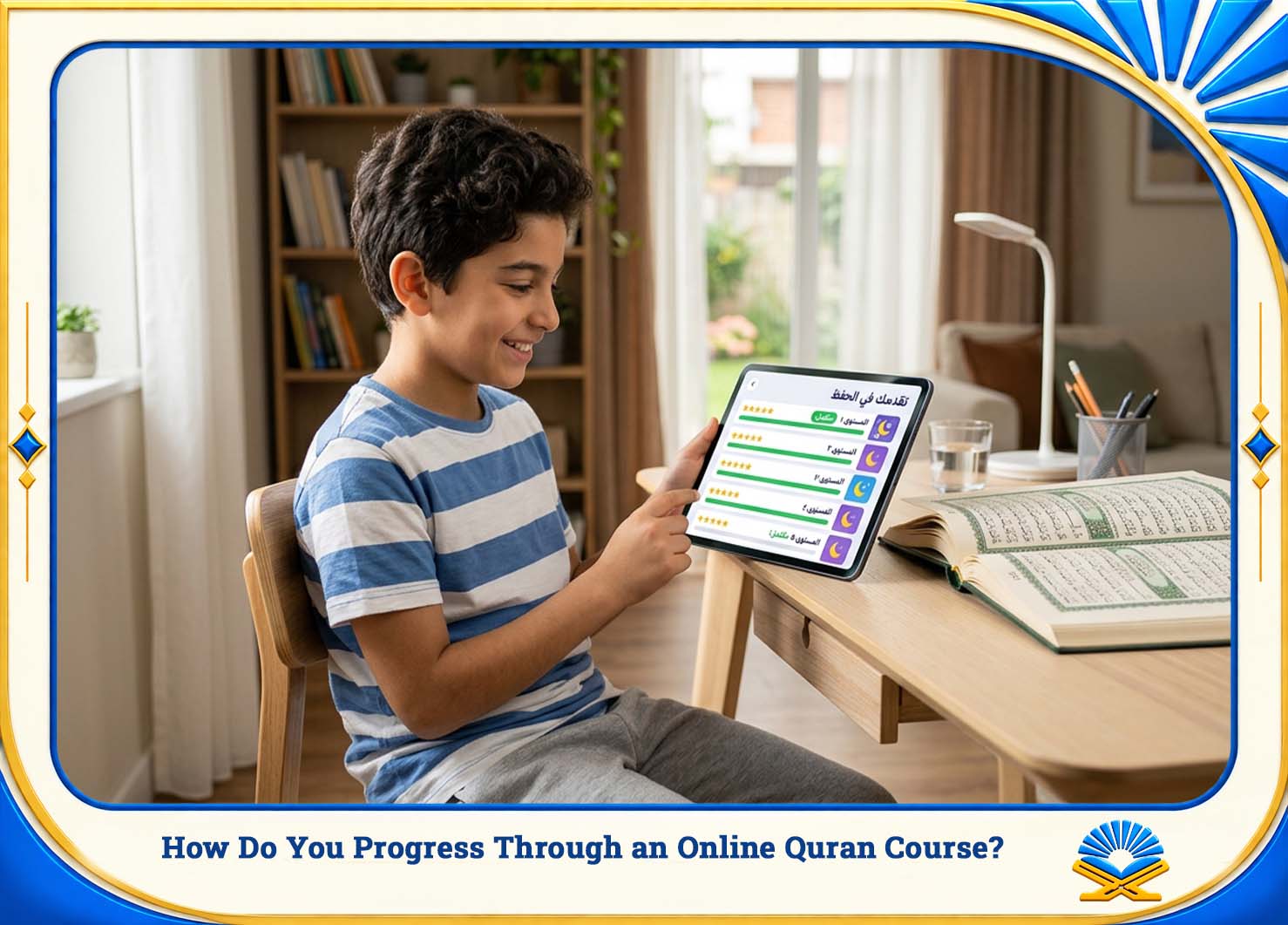
Progress should be based on demonstrated skills rather than simply completing a certain number of lessons. A typical progression may look like this:
- Learn the skills required at the current level.
- Practice those skills during Quran lessons.
- Receive corrections and teacher feedback.
- Review areas that still need improvement.
- Demonstrate greater consistency.
- Move toward the next stage when the required skills are sufficiently developed.
For example, a learner may be ready to progress after becoming comfortable with the reading skills expected at the current level. Another learner may need additional practice because those skills are not yet consistent.
This approach helps prevent learners from moving ahead before they are ready while avoiding unnecessary repetition for students who are progressing well.
What Does a Typical Online Quran Lesson Look Like?
The structure of an online Quran lesson depends on the learner’s level and goals. A well-organized program should connect each lesson with the learner’s current needs, curriculum, and overall learning plan.
Reviewing factors such as lesson structure, teacher guidance, and progression can also help when comparing best online quran classes. A reading-focused lesson may include:
- Reviewing previous material
- Reading Quranic words or verses
- Correcting pronunciation
- Practicing relevant Tajweed rules
- Receiving teacher feedback
- Assigning material for continued practice
A memorization lesson may instead give more time to new verses and revision of previously memorized portions.
The important point is that the lesson structure should support the curriculum rather than operate as an isolated weekly session.
How Is Progress Evaluated?
Progress should be evaluated according to the skills associated with the learner’s current goal. For Quran reading, the teacher may observe:
- Accuracy of letter pronunciation
- Reading fluency
- Application of basic Tajweed
- Recurring pronunciation mistakes
- Ability to read unfamiliar verses
When memorization is the main goal, evaluation may focus on:
- Accuracy of newly memorized verses
- Retention of previous portions
- Ability to connect verses
- Recitation without excessive prompting
Advanced learners may also be assessed through more detailed recitation and the practical application of Tajweed rules.
Regular feedback helps learners understand which areas require additional practice and whether they have developed the skills needed for the next stage.
How Can Parents Choose a Quran Course for a Child?
Parents should consider the child’s current Quran reading ability, age, learning objective, and available study time.
For younger learners, programs such as quran classes for kids can be evaluated based on age-appropriate lessons, teacher guidance, and the child’s current reading level.
Instead of choosing a course only because it offers many levels, parents should examine whether the curriculum explains what children actually learn at each stage. Useful questions include:
- Does the course begin with the child’s actual ability?
- Is the curriculum appropriate for the child’s age?
- How does the teacher correct reading mistakes?
- How is memorization balanced with revision?
- How is the child’s progress monitored?
- Can the learning pace be adjusted when necessary?
A child who is beginning with Arabic letters may benefit from online quran classes for children, while a child who already reads Quranic verses independently may need a more advanced learning path.
What Should Adults Ask Before Enrolling?
Adults often have different schedules and learning objectives, so the course should be compatible with both. Before enrolling, ask:
- Which level would I start at?
- What does the curriculum cover at that level?
- How often are lessons held?
- How is progress evaluated?
- Can the pace be adjusted?
- Can I focus on reading, Tajweed, memorization, or another specific goal?
Adults who need greater flexibility can also explore online quran classes for adults and compare the curriculum, lesson structure, and progression system with their personal goals.
These questions can help determine whether the course matches your actual needs before committing to a long-term learning plan.
Common Mistakes When Choosing an Online Quran Course

Choosing a course based only on its name or the number of subjects it offers can lead to a poor match. Common mistakes include:
Starting at the Wrong Level
Some learners choose an advanced level because they have studied Quran previously. However, previous experience does not always mean that the learner has mastered the skills required for that level.
A current-level assessment can help identify the skills that need attention before moving forward.
Focusing Only on New Material
This is particularly important for memorization. Adding new verses without enough revision can make retention more difficult.
A balanced approach should give previously memorized portions enough attention to remain strong.
Ignoring the Curriculum
A convenient schedule is useful, but the curriculum determines what the learner will actually study.
Before enrolling, check the topics, skills, progression system, and learning objectives rather than looking only at lesson availability.
Choosing Speed Over Consistency
Trying to progress as quickly as possible may not produce better long-term learning. A sustainable pace can make regular practice and revision easier to maintain.
Expecting Every Learner to Follow the Same Path
Children, adults, beginners, experienced readers, and memorization students can have very different needs.
The course should therefore be evaluated according to the learner’s starting point and objective.
Learners who are new to Quran reading can also consider online quran classes for beginners to understand how a foundational program may differ from courses designed for more experienced readers.
Which Online Quran Course Level Do You Need?
Your starting level should be based on your current ability rather than your age or how long you have studied the Quran in the past. Consider the following situations:
- If You Cannot Read Arabic Yet: You will generally need a foundational level that starts with Arabic letters, sounds, vowels, and simple word reading. Starting with advanced Tajweed before developing basic reading skills can make the learning process unnecessarily difficult.
- If You Can Read but Make Frequent Mistakes: A Quran reading and basic Tajweed level may be more appropriate. The focus should be on identifying recurring pronunciation problems and developing more accurate reading habits.
- If You Already Read the Quran Reasonably Well: You may benefit from a course that focuses more directly on Tajweed, recitation accuracy, or another specific learning goal. Instead of repeating basic material, the teacher can identify areas that need improvement and build lessons around them.
- If Your Main Goal Is Memorization: You need a curriculum that balances new memorization with revision. Your starting point may also depend on how much Quran you have already memorized and how well you can retain previously learned portions.
- If You Want Deeper Quran Study: You may need a more advanced program rather than a basic Quran reading course. Before enrolling, identify exactly what you want to study so the curriculum can match your objective.
What Should a Good Quran Course Curriculum Include?
A useful curriculum should give learners a clear idea of what they are learning, how they will practice it, and why each stage comes before the next.
Clear Learning Objectives
Each level should have identifiable learning goals. For example, a beginner level may aim to develop accurate letter recognition and pronunciation, while an intermediate level may focus on applying Tajweed during actual Quran recitation.
Clear objectives help learners understand what they are expected to achieve before moving forward.
Logical Progression
The curriculum should move from foundational skills toward more advanced ones. Learners should not be expected to master advanced rules before developing the basic reading and pronunciation skills needed to apply them. A logical sequence also helps prevent gaps between levels.
Practical Quran Learning
Quran learning should involve regular practice rather than relying only on explanations. Students need opportunities to read, recite, memorize, revise, and receive corrections according to their level.
Practical application allows learners to turn what they study into consistent reading and recitation skills.
Appropriate Learning Pace
Students do not all progress at the same speed. A useful course should allow the pace to reflect the learner’s age, ability, available study time, and learning objectives.
A realistic pace can also make regular practice and revision easier to maintain.
Progress Evaluation
Learners should receive feedback that shows what they have improved and what still needs attention.
Evaluation does not necessarily mean formal examinations. It can also involve teacher observations, recitation checks, memorization reviews, and regular progress discussions.
How Hamel El-Quran Academy Can Fit Into Your Learning Plan?
Learners considering Hamel El-Quran Academy can use the same criteria discussed throughout this guide when reviewing a course.
Start by identifying your current Quran reading ability and main learning objective. Then consider whether the available learning structure matches your needs in areas such as curriculum, level placement, progression, practice, and assessment.
Whether your goal is Quran reading, Tajweed, recitation, or memorization, connecting the program with a clear objective and a realistic learning pace can make the learning process more organized.
What Should You Do Before Enrolling in an Online Quran Course?
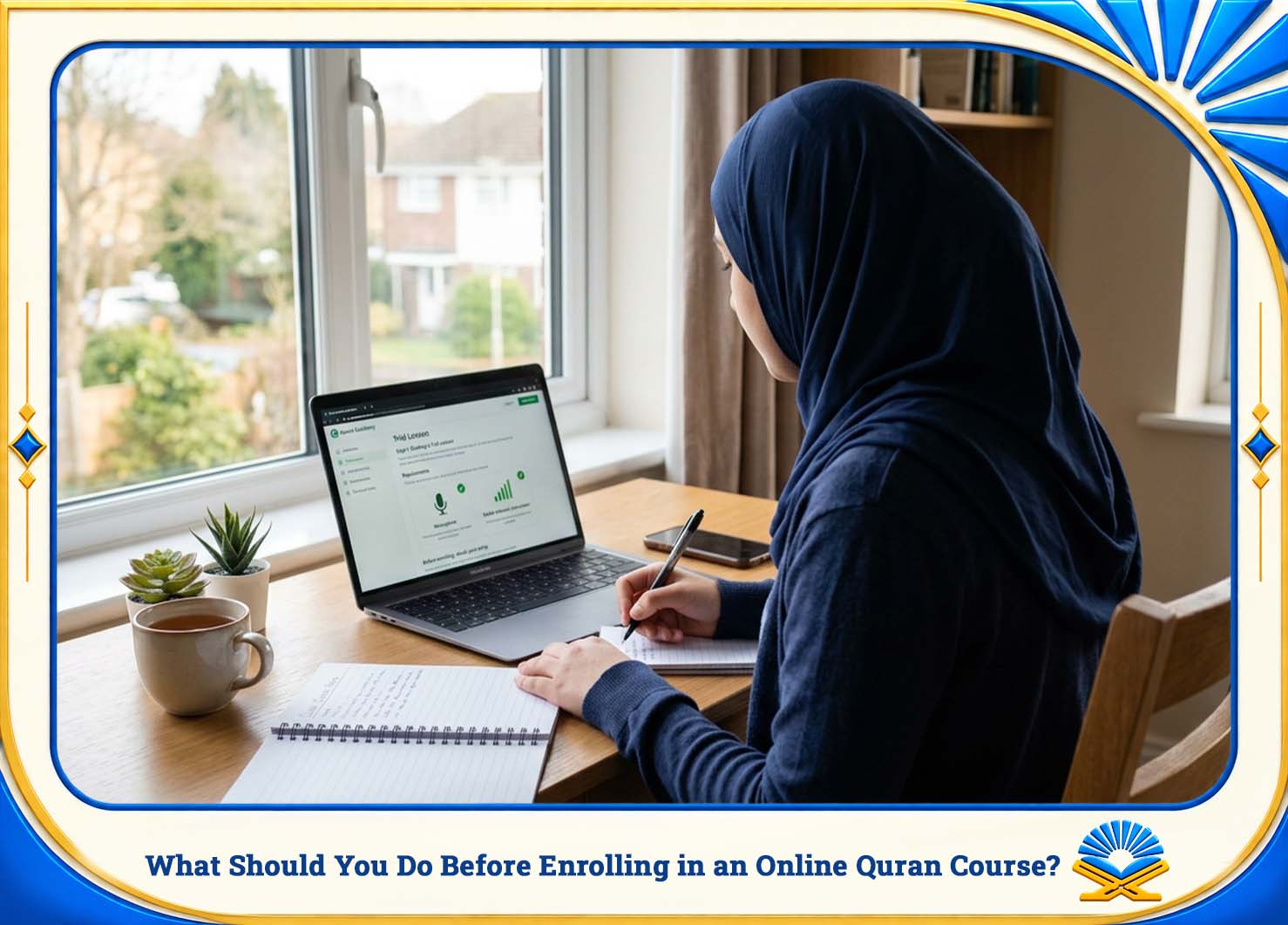
Before choosing an online quran course, take a few moments to review the program’s curriculum, learning levels, lesson structure, and progress system.
A simple checklist can help you compare your learning needs with what the course provides and make sure you choose a program that supports your goals and current Quranic ability.
- Identify Your Current Level
Determine whether you are learning Arabic letters, developing Quran reading skills, improving Tajweed, memorizing the Quran, or working at a more advanced level. - Define Your Main Goal
Decide whether you want to read the Quran accurately, improve recitation, learn Tajweed, memorize the Quran, or develop another specific skill. - Review the Curriculum
Check what is actually taught at your starting level and what skills are expected before moving forward. - Understand the Progression System
Find out how learners move from one level to another and whether progression depends on demonstrated skills. - Ask How Progress Is Measured
Understand what type of feedback you will receive and how the teacher identifies areas that need additional practice. - Choose a Sustainable Pace
Select a schedule that you can maintain consistently rather than choosing a pace that may become difficult to follow.
Frequently Asked Questions
The following frequently asked questions address common concerns about online Quran course levels, learning options, and choosing a suitable program.
1. What is an online Quran course?
An online Quran course is a structured learning program delivered remotely. Depending on the curriculum, it may focus on Quran reading, pronunciation, Tajweed, recitation, memorization, or other Quran-related skills.
2. How do I know which Quran course level I should start with?
Your starting level should depend on your current Quran reading ability and learning objective. A learner who cannot read Arabic needs a different starting point from someone who already reads fluently and wants to improve Tajweed.
3. Can an online Quran course include memorization?
Yes. Some online Quran courses include memorization as part of their curriculum. A suitable memorization plan should include both new material and regular revision.
4. How long does it take to complete an online Quran course?
There is no single timeframe for every learner. The duration depends on the starting level, curriculum, learning goal, lesson frequency, available practice time, and individual progress.
In conclusion, choosing an online quran course should begin with a clear understanding of your current Quran reading ability, learning goals, and preferred pace. A suitable course should provide a structured curriculum that explains what learners study at each level and how they can progress as their skills improve.
The right program should also give enough attention to practical recitation, Tajweed, memorization, revision, and regular feedback. These elements can help learners identify areas that need more practice and build stronger Quran learning habits over time.
Before enrolling, compare the course levels, lesson structure, curriculum, progress evaluation methods, and flexibility. Parents should also consider whether the program suits their child’s age and ability, while adults may need a schedule that fits their responsibilities.
By taking these factors into account, learners can make a more informed choice and select an online quran course that matches their needs, supports consistent practice, and provides a clear path toward their Quran learning goals.