

A learn quran course should offer more than a series of lessons. It should show you where to begin, what to learn next, how to practice, and how to recognize meaningful improvement.
Hamel El-Quran Academy provides an online Quran learning approach for students who want to develop their reading, recitation, Tajweed, or memorization skills through a structured learning path.
Quran learning looks different from one person to another. A complete beginner may need to start with Arabic letters and basic reading, while another learner may already read the Quran but need help with pronunciation, Tajweed, fluency, or memorization.
That is why a clear learning journey matters. Instead of moving through lessons without knowing what comes next, you can build your studies around your current ability, immediate needs, and long-term goals.
Whether you want to improve your reading, study Tajweed, understand Quranic meanings, or gradually memorize selected portions, a structured learn quran course should help you develop one skill at a time and use it as a foundation for the next.
How a Learn Quran Course Builds Your Learning Journey?
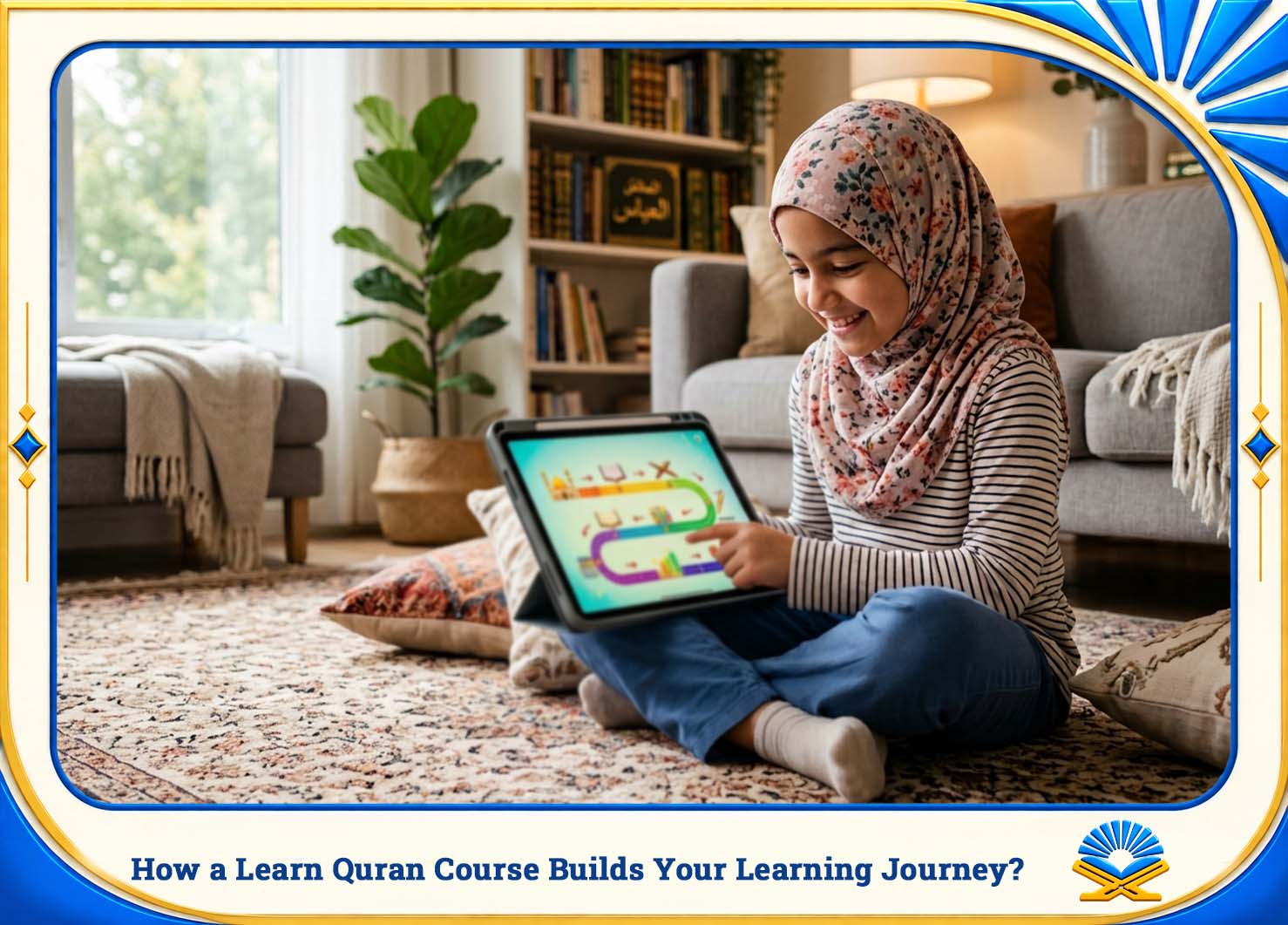
A course can give you lessons. A learning journey gives those lessons direction. For example, learning Arabic letters is useful, but it is only the beginning if your goal is to read the Quran independently.
After recognizing letters, you need to understand how they connect, read vowel marks, pronounce words correctly, and apply those skills to actual Quranic verses.
The same principle applies later. Studying a Tajweed rule is useful, but the real skill comes from recognizing and applying it during recitation. A useful learning path therefore connects each skill to the next:
Reading foundation → accurate pronunciation → better recitation → fluency → personal goals
Not every learner needs to follow the same order or spend the same amount of time on each skill. The important question is:
What should I be able to do before I move forward?
That question keeps the focus on ability rather than simply completing lessons. It is also one of the main things to consider when choosing a learn quran course.
Start Your Quran Learning Journey Today
Are you ready to learn the Quran with confidence and consistency? Hamel El-Quran Academy offers online Quran learning opportunities designed to help students improve their Quran reading, recitation, Tajweed, and memorization from home. With structured lessons and personalized guidance, you can develop your skills step by step according to your learning goals.
Join Hamel El-Quran Academy today and take the next step toward building a stronger and more meaningful connection with the Quran.

The First Step: Know Where You Are Starting
Before choosing a course, identify your actual Quran reading level. Many learners describe themselves as beginners because they are not fluent, even though they already recognize Arabic letters and can read short surahs. Others may read quickly but have pronunciation or Tajweed issues that they have never received direct feedback on. A simple self-assessment can help you identify your starting point. Ask yourself:
- Can I recognize Arabic letters easily?
- Can I read letters when they are connected?
- Do I understand common vowel marks?
- Do I hesitate when reading Quranic words?
- Can I pronounce Arabic sounds accurately?
- Do I know basic Tajweed rules and apply them?
- Can I read several verses continuously without frequent mistakes?
Your answers help determine what you need now rather than what someone else needed when they started.
This matters because starting too far below your ability can make learning unnecessarily repetitive. Beginning above your level, however, can create gaps that become harder to correct later.
A suitable learn quran course should reflect this starting point instead of assuming that every learner needs the same introduction.
Build a Strong Quran Reading Foundation
For a complete beginner, the priority is usually accurate reading. This stage may include:
- Arabic letters and their different forms
- Letter connections
- Short and long vowel sounds
- Basic reading patterns
- Common Quranic symbols
- Reading simple words and short passages
The objective is not to read as quickly as possible. Accuracy comes first. A learner who develops incorrect pronunciation early may continue repeating the same mistakes for a long time. Building the foundation carefully gives later recitation practice a stronger base.
Once you can recognize letters and read basic combinations with greater confidence, you can begin applying those skills to Quranic text.
For beginners, a learn quran course should give enough attention to these basics before introducing more demanding recitation skills.
Move From Basic Reading to Quranic Text
Knowing Arabic letters does not automatically mean you can read the Quran comfortably. Quranic text introduces longer words, connected sounds, familiar patterns, and pronunciation challenges that may not appear during basic alphabet practice.
This is where learn quran classes can become particularly useful. Instead of practicing isolated examples indefinitely, you begin working with actual verses while receiving correction as needed.
For learners starting from the alphabet or basic reading level, online quran classes for beginners can be relevant when comparing ways to build these early skills.
A good lesson should help you notice what is causing difficulty. For example, if you repeatedly pause because you are unsure how letters connect, the solution may be additional reading practice. When a specific sound is incorrect, pronunciation practice may need greater attention.
The skill being practiced should match the problem being corrected.
From Correct Reading to Better Recitation
Once basic reading becomes more comfortable, the focus can shift toward making recitation more accurate and consistent. Pronunciation is an important part of this process. Some Arabic letters require sounds that may not exist in a learner’s first language, so hearing a correct recitation does not always reveal whether your own pronunciation is accurate. A practical correction cycle is:
Listen → repeat → read → receive correction → practice again
Tajweed can then be introduced and practiced through the Quranic text rather than treated as a collection of definitions. Depending on your level, this may involve areas such as articulation points, letter characteristics, Noon Sakinah and Tanween, Meem Sakinah, Madd, Qalqalah, and stopping and starting.
You do not need to master every rule at once. What matters is understanding a rule, recognizing where it occurs, and gradually applying it during your own recitation.
This is where an online quran course can connect explanation with actual reading practice. Each new concept becomes useful when you can hear it, identify it, and apply it in a verse.
For a course that combines structured study with online lessons, an online quran course can also be considered alongside other available learning options.
Turning Practice Into Fluent Recitation
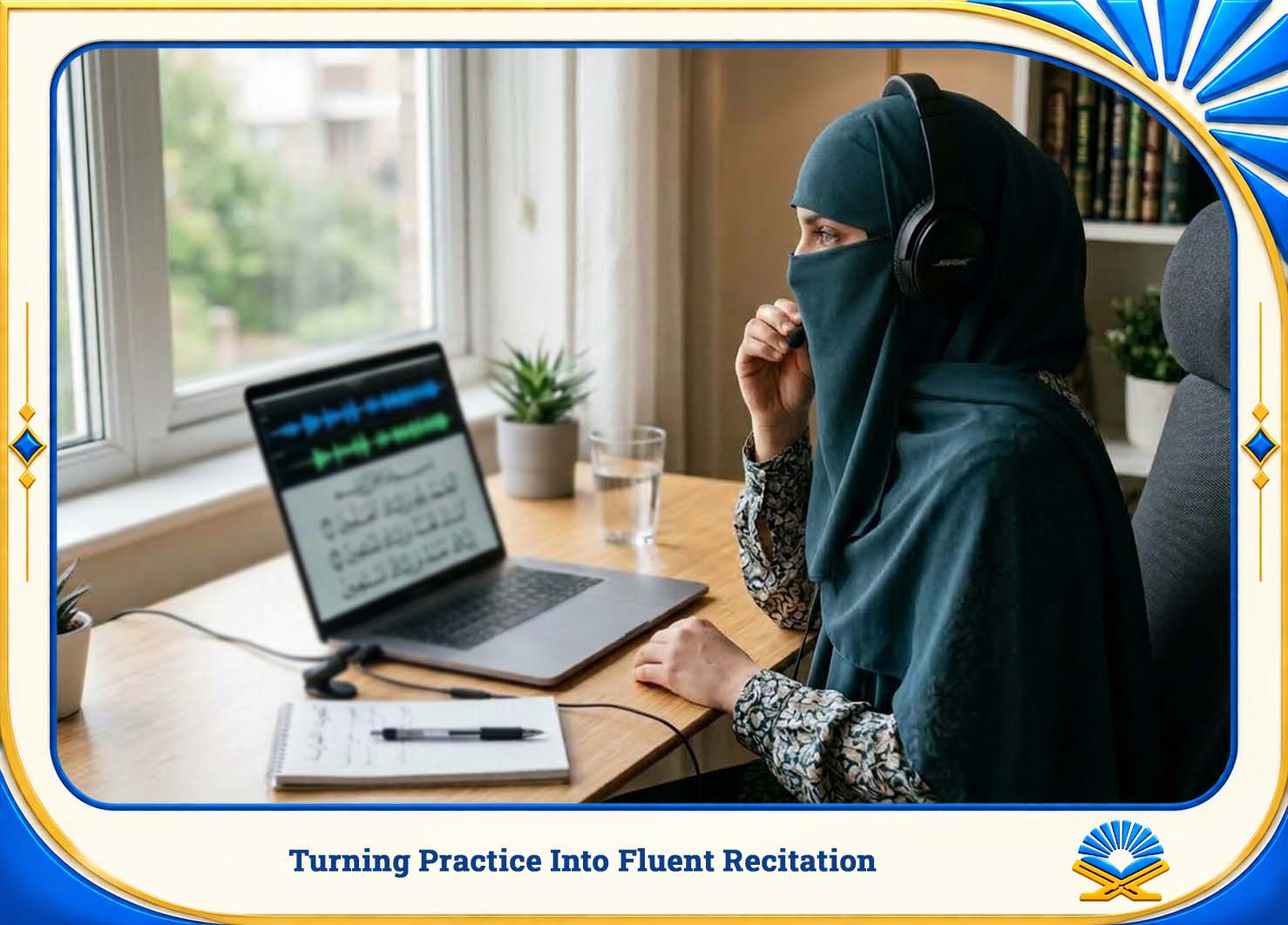
Correct reading and fluent reading are related, but they are not the same. A learner may know the letters and apply basic Tajweed rules while still stopping frequently or struggling to connect words smoothly. Fluency develops as accurate reading becomes more familiar through repeated practice. Instead of trying to increase speed immediately, practice can gradually move from:
- Individual words
- Short phrases
- Complete verses
- Several connected verses
- Longer passages
Repeated reading helps reduce hesitation while keeping pronunciation under control. The goal is not fast recitation for its own sake. It is the ability to maintain accurate pronunciation and apply learned rules without having to stop at every word.
As the process becomes more familiar, reading can feel less like decoding individual words and more like continuous recitation. A learn quran course can support this development when lessons give enough attention to both accuracy and repeated application rather than treating fluency as a matter of simply reading more pages.
Let Your Goals Shape the Next Step
A Quran learning journey does not have to end with fluent reading. What comes next depends on what you want to achieve.
For some learners, improving recitation and Tajweed may be the main goal. Others may want to understand Quranic vocabulary and meanings more deeply. Another learner may want to begin memorizing selected surahs after building a stronger reading foundation. These goals can develop gradually rather than being treated as separate paths.
For example, understanding can be added through vocabulary, the meanings of selected verses, themes of surahs, or reliable explanations. Memorization can be introduced when reading is sufficiently stable, followed by regular revision to maintain what has been learned.
Your goals may also change as your ability develops. You may begin by wanting to read the Quran, then become interested in Tajweed, and later decide to focus more on understanding or memorization. A flexible learning path should leave room for those changes.
When comparing a learn quran course, consider whether it can support the goal you have now while leaving room for the direction you may choose later.
Your Learning Journey Does Not Need to Follow Someone Else’s Timeline
Two learners can study the same material and progress at very different rates. One learner may already recognize Arabic letters and need help with Tajweed. Another may be starting from the alphabet. A third may read fluently but want to focus mainly on memorization. Their learning paths should not be identical.
Your schedule can also affect the pace. Someone studying several times a week may move through material differently from someone with limited time.
For that reason, comparing the number of lessons completed with another learner does not provide a reliable measure of improvement. A better comparison is with your own previous ability.
Can you read something today that was difficult a few weeks ago? Are you making fewer pronunciation mistakes? Can you apply a Tajweed rule without being reminded? Can you recite a passage with fewer unnecessary pauses? These questions provide more useful evidence.
How Can Online Quran Learning Follow Your Progress?
One advantage of online quran learning is that lessons can be organized around the learner’s current needs rather than treated as a fixed sequence with no adjustment. A useful learning cycle can be simple:
Assessment → Instruction → Practice → Feedback → Adjustment
- First, identify the skill that needs attention.
- Then learn or review the relevant concept.
- Next, practice it through Quranic reading.
- After that, receive feedback on mistakes.
- Finally, adjust the next lesson or practice session according to what still needs improvement.
This approach keeps lessons connected to actual performance. It also prevents a common problem: continuing to introduce new material when an earlier skill has not yet become stable.
For someone comparing an online quran course with other learning options, this type of progression is worth considering because it connects instruction with actual performance.
What a Meaningful Lesson Should Produce
A lesson should leave you with something you can identify. That might be:
- A new reading skill
- Better pronunciation of specific letters
- A Tajweed rule you can apply
- A passage you can read more fluently
- A section you can recite from memory
- A clearer understanding of selected verses
You should also know what needs practice afterward. If you finish a lesson without knowing what improved, what remains difficult, or what you should practice next, it becomes harder to maintain direction. A useful lesson therefore connects three points:
What did I learn? → What do I need to practice? → What comes next? That simple structure can make your studies more organized without making them complicated.
How to Practice Between Lessons?
Lessons alone are rarely enough to build lasting reading and recitation skills. Between lessons, practice should focus on the specific areas that need reinforcement. You can:
- Review the previous lesson
- Read the assigned verses aloud
- Repeat difficult words
- Practice corrected pronunciation
- Apply recently learned Tajweed rules
- Record your recitation for self-review
- Note recurring mistakes
- Prepare the next passage before the lesson
Short, focused practice can be more useful than occasional long sessions that are difficult to maintain. Consistency also gives your teacher clearer evidence of what is improving and what still needs attention.
How to Measure Real Progress?
Progress should be measured through practical ability rather than lesson count. Useful indicators include:
- Reading accuracy: Can you read familiar passages with fewer errors?
- Pronunciation: Are difficult letters becoming more consistent?
- Tajweed application: Can you recognize and apply rules during recitation?
- Fluency: Are pauses becoming more purposeful and less frequent?
- Retention: Can you remember previously learned material?
- Independence: Do you need fewer corrections for skills you have already studied?
These indicators provide a clearer picture than simply saying that you completed a certain number of classes. A learner may complete many lessons without mastering a particular skill. Another may need more time on one area but develop a stronger foundation as a result.
When evaluating a learn quran course, these practical outcomes are more useful than judging the program only by the number of lessons or topics it includes.
What to Do When Progress Slows Down?
Progress does not always move at the same pace. A learner may improve quickly at first and then reach a point where the same mistakes continue appearing. This does not necessarily mean that the entire approach has failed.
First, identify the specific difficulty. When pronunciation is the issue, return to the affected sounds and practice them carefully. For fluency problems, shorter passages and repeated reading can help build smoother recitation. If memorization becomes difficult, increase revision before adding more new material.
Sometimes the best step forward is a short return to an earlier skill. Reviewing a foundation is not the opposite of progress. It can be the step that makes later improvement possible.
When Should You Move Forward?
Moving forward should depend on readiness rather than the number of lessons completed. You may be ready when you can perform the current skill with reasonable consistency and no longer depend on constant correction. For example, before moving into more advanced recitation practice, you should be able to read the relevant Quranic text with sufficient accuracy to benefit from the next level.
This does not mean you must become perfect before progressing. Learning often works through overlap. You can begin a new skill while continuing to strengthen an earlier one. The key is avoiding a situation where the next area becomes difficult because an essential foundation is still missing.
Where Learn Quran Classes Fit Into the Process?
Learn quran classes can provide structure around the parts of the journey that are difficult to manage alone. Before a lesson, you can review previous material and identify the areas that need attention. During the lesson, the focus can be placed on explanation, reading practice, correction, and application.
After the lesson, you can continue practicing the specific skills covered. This creates a complete learning cycle rather than treating the class as an isolated event.
When choosing classes, consider whether the teaching approach matches your current reading level, your goals, the amount of practice you can realistically maintain, and the type of feedback you need.
Where Hamel El-Quran Academy Fits Into the Learning Journey?
Hamel El-Quran Academy can be considered an option for learners looking for structured Quran study online. The important point when evaluating any academy is not simply the number of courses available. Look at whether the learning path matches your current ability and goals.
For families looking specifically at children’s programs, online quran classes for children and online quran learning for kids are relevant pages to review based on the learner’s age and needs.
Adult learners can also compare options such as online quran classes for adults when looking for a learning path that fits their existing reading level and goals. Before enrolling, consider questions such as:
- Where would I begin based on my current reading level?
- Does the course address the skill I actually need?
- How are reading and pronunciation mistakes handled?
- Can the lessons support my longer-term goal?
- Is the study structure realistic for my schedule?
These questions help you evaluate whether a course fits your own learning journey instead of choosing one simply because it contains many lessons.
How Your Goal Can Develop Over Time
Your original reason for studying the Quran may change as your skills improve. You might begin because you want to read basic Quranic text. Once reading becomes easier, you may become more interested in Tajweed. Later, you may want to memorize selected surahs or study meanings more deeply.
That development is normal. Your course should therefore be able to support changing priorities without forcing every learner into the same path. Think of your goal in layers:
Read correctly → Recite accurately → Apply Tajweed → Build fluency → Understand more → Memorize and retain
Not every learner will emphasize every layer equally. The value of a structured learning path is that it gives you room to develop according to your needs.
Building a Sustainable Quran Learning Routine
A learning journey becomes difficult to maintain when the schedule is unrealistic. Instead of creating a routine that demands more time than you can consistently give, choose a pattern that fits your actual week. A sustainable routine might include:
- A regular lesson schedule
- Short reading practice between lessons
- Dedicated revision time
- Occasional progress reviews
- Clear goals for the next period of study
Your routine can change when your circumstances change. The important part is maintaining enough consistency for previous learning to remain active. A manageable routine also makes it easier to notice gradual improvement because you are practicing often enough to build continuity.
The Real Goal of a Learn Quran Course
The value of a learn quran course should not be measured by how much material you have completed. It should be reflected in what you can actually do.
Can you read with greater accuracy? Are difficult letters becoming easier to pronounce consistently? Can you apply Tajweed rules while reciting? Do longer passages feel more fluent and connected? Are you able to remember what you have learned? Can you understand selected verses more clearly?
These abilities are more meaningful than simply moving from one lesson number to another. A well-organized course should give you direction while allowing your progress to determine what deserves attention next.
How to Start Your Learn Quran Course at the Right Level
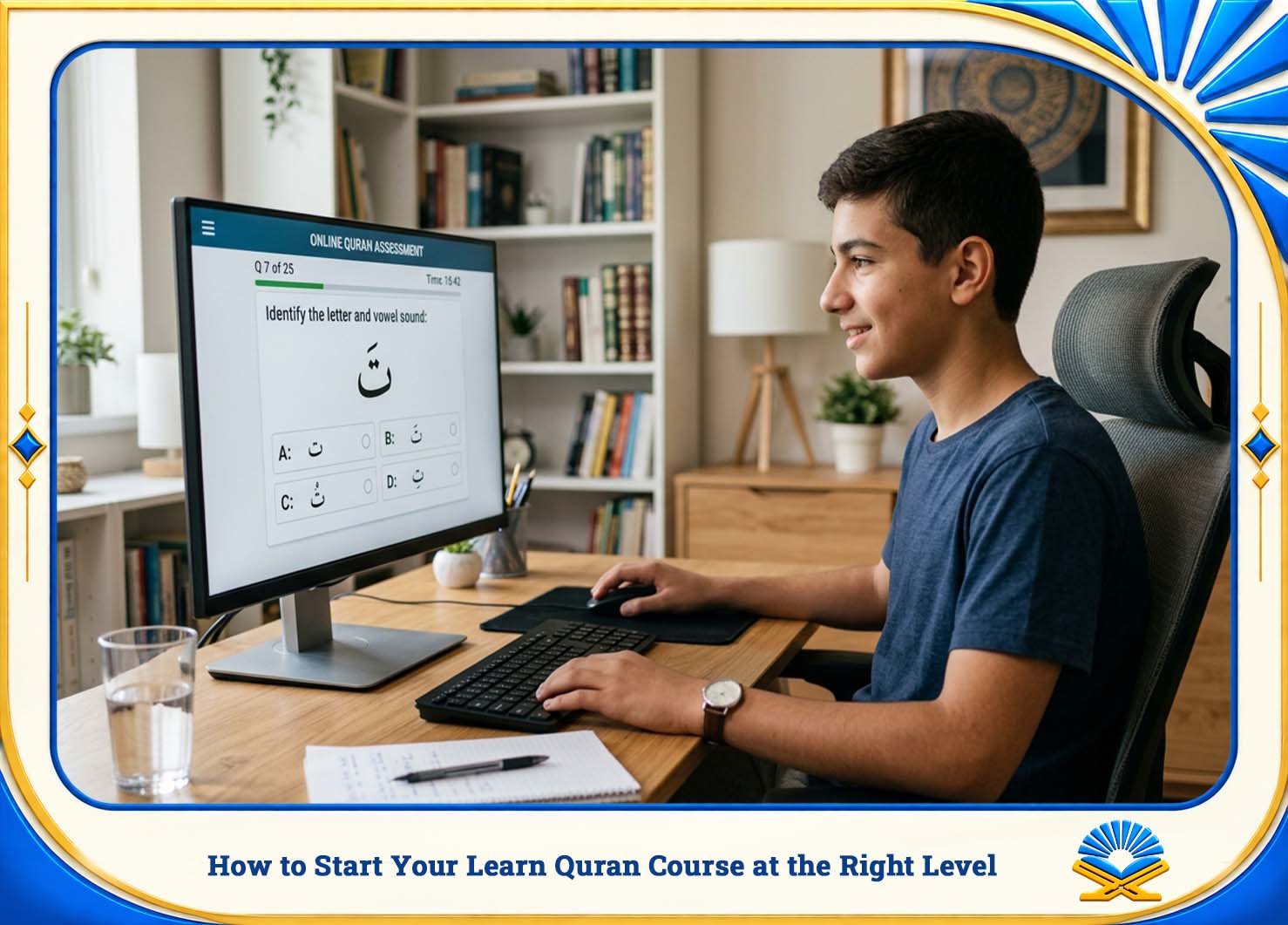
Starting does not require planning your entire Quran education at once. Begin by identifying your current ability and choosing one immediate goal.
For a complete beginner, the immediate goal may be learning to read Arabic letters and simple Quranic words. Learners who can already read may need pronunciation correction or more Tajweed practice. Those with established recitation can then focus on fluency, understanding, or memorization.
From there, compare online quran courses based on how clearly they address your level, goals, teaching approach, and practice needs.
If you are specifically looking for a learn quran course, use the same checklist: identify your current level, define your immediate goal, and make sure the course addresses the skill you need to develop now.
The best starting point is not the course with the longest list of lessons. It is the one that gives you a clear answer to a simple question: What should I work on next? Once that answer is clear, your Quran learning journey becomes easier to organize, practice, and evaluate.
Frequently Asked Questions
Here are answers to common questions about choosing a learn quran course and building a clear Quran learning journey.
Can a complete beginner start a learn quran course?
Yes. A complete beginner can start with the Arabic alphabet, letter pronunciation, connections, vowel marks, and basic Quran reading. The important point is to begin at the appropriate level rather than skipping essential foundations.
How do I know which stage of the Quran learning journey I am in?
Struggling with letters and basic reading means you need to build a strong foundation first. Learners who can read but make pronunciation mistakes may need more attention to pronunciation and Tajweed. For those who read accurately but hesitate, improving fluency may be the next focus.
Should I learn Tajweed before becoming fluent in Quran reading?
Basic pronunciation and reading skills should come first because they allow you to understand and apply Tajweed rules more effectively. However, fluency and Tajweed can develop together once your foundation is strong enough.
Can memorization be added later to my Quran learning journey?
Yes. Memorization can be introduced after your reading and pronunciation are sufficiently stable. It is also important to maintain regular revision so that previously memorized passages remain strong.
In conclusion, choosing a learn quran course should be based on where you are now, what you want to achieve, and how you can continue improving over time. A clear learning journey connects reading foundations with pronunciation, Tajweed, fluency, understanding, and memorization according to your individual needs.
Rather than focusing only on the number of lessons completed, look at the skills you are developing and the areas that still need practice. With the right structure, consistent practice, and meaningful feedback, each stage can prepare you for the next.
Whether you are starting from the Arabic alphabet or working to strengthen your recitation, begin with one clear goal and let your progress guide the next step.